



The Dolby Theatre Coronation
Walking into the 98th Academy Awards on March 15, there was an undeniable electricity in the air that had nothing to do with the usual Hollywood artifice. We’ve seen K-culture permeate the global consciousness for years, but the win for K-Pop Demon Hunters in the Best Animated Feature category felt like something else entirely. It wasn’t just a win for a Netflix film; it was a definitive crowning of a new genre. When Maggie Kang took the stage, the atmosphere shifted from celebratory to historic. This wasn’t merely about technical achievement in animation—though, cinematically speaking, it is a marvel—it was about the validation of a specific cultural identity that has long been relegated to the ‘niche’ or ‘trend’ categories by Western gatekeepers.
Director Maggie Kang’s acceptance speech resonated with a raw honesty that we rarely see at the Dolby Theatre. Her apology to the younger generation for how long it took to see themselves on screen wasn’t just a soundbite; it was a critique of the industry’s slow-moving gears. As a critic who has watched the evolution of Korean storytelling from the early Hallyu waves to the Parasite era, seeing an animated feature bridge the gap between Sony Pictures Animation’s high-octane visual style and the intricate, often grueling world of K-pop training was nothing short of a masterclass in cross-cultural synthesis. The film has already shattered Netflix records since its March 15 release, but the Oscar gold cements its legacy beyond mere streaming numbers.
“This award is for Korea, and for every Korean around the world. Music and stories have the power to connect people across cultures and borders. To the young filmmakers and artists everywhere: tell your story. Sing in your own voice. The world is waiting for you.” — Maggie Kang, Director
Kinetic Energy: The Sony Animation Signature
Technically, K-Pop Demon Hunters is a successor to the visual language established by the Spider-Verse franchise, yet it carves out its own distinct aesthetic. The mise-en-scène is a neon-drenched love letter to Seoul, but it’s the frame-rate manipulation that really steals the show. The directors chose to animate the ‘demon hunting’ sequences with a jagged, high-energy fluidity that mirrors the precision of idol choreography. It’s a brilliant directorial choice; the movement of the characters feels like a dance, even when they are slicing through eldritch horrors in the back alleys of Gangnam. The color grading shifts seamlessly from the sterile, fluorescent lights of a training studio to the hyper-saturated purples and magentas of the supernatural realm, creating a visual duality that perfectly mirrors the protagonists’ double lives.
What elevates this film above typical action-fantasy fare is the attention to detail in the ‘idol’ side of the story. The production design of the practice rooms, the specific wear and tear on the dance floor, and the way the light hits the sweat on a trainee’s brow all speak to a level of research and respect for the source culture. Sony Pictures Animation didn’t just skin a generic story with K-pop aesthetics; they built the world from the rhythm up. The action isn’t just there for the sake of spectacle—it’s an extension of the characters’ internal struggles. Every kick and flip feels earned, a physical manifestation of the discipline required to survive the idol industry.
‘Golden’: When the OST Becomes the Narrative
We cannot discuss this film without analyzing the sonic landscape curated by the team. The lead single “Golden” didn’t just win an Oscar; it already secured a Grammy for Best Song Written for Visual Media earlier this year. In the context of the film, “Golden” serves as the emotional spine. It’s not just a track that plays over the credits; it’s the ‘MacGuffin’ of the emotional arc, the song the characters are fighting to perform while literally fighting for their lives. The way the music is integrated into the sound design—muffled through walls during tense dialogue, then exploding into full Dolby Atmos glory during the climax—is a masterclass in auditory storytelling.
Unpopular opinion, but I find the OST more impactful than many live-action musical scores from the past decade. The track doesn’t just lean on catchy hooks; it incorporates traditional Korean instruments layered under modern synth-pop beats, mirroring the film’s theme of tradition versus modernity. The lyrics, which speak to the burden of being ‘golden’ in the eyes of the public, add a layer of melancholy that grounds the high-fantasy elements. When that beat drops during the final battle at the Lotte World Tower, it’s one of the most exhilarating moments in modern cinema. It’s the kind of synergy between sight and sound that reminds you why we go to the movies in the first place.
The Identity Crisis: Sony vs. Seoul
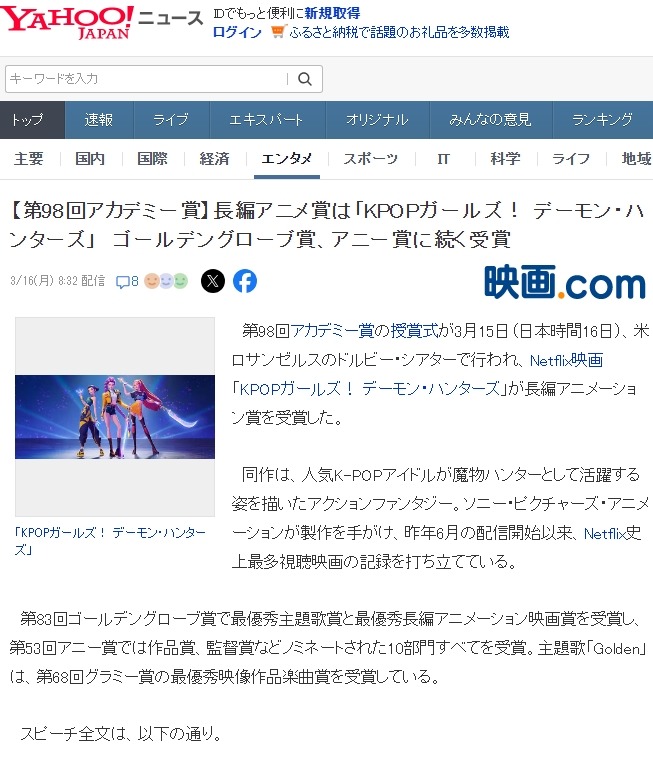
However, the film hasn’t been without its detractors, particularly regarding its ‘nationality.’ Following the Oscar win, Japanese social media platforms like Yahoo Japan and 5ch have been buzzing with a specific type of skepticism. Some viewers argue that because the film was produced by Sony Pictures Animation—a US-based subsidiary of a Japanese conglomerate—labeling it a ‘Korean’ victory is a stretch. This discourse touches on the complex tension between globalized production and cultural ownership. Does a film belong to the culture it depicts, the director who helmed it, or the corporation that funded it?
“I don’t mean to be a hater, but I wish they wouldn’t lean so hard into nationalism for entertainment. This feels more like a Sony Pictures work than a ‘Made in Korea’ project, even if the theme is Hallyu. It’s a bit much to claim this as a total victory for Korean cinema.” — Japanese Netizen (kon********)
As a critic, I find this perspective fascinating but ultimately reductive. The ‘Made in Korea’ label shouldn’t be a matter of where the tax breaks were filed, but whose perspective is being centered. Maggie Kang’s vision is undeniably Korean-American, and the soul of the film is rooted in the specific anxieties and triumphs of the Korean diaspora and the Hallyu phenomenon. To dismiss it as purely a corporate product is to ignore the artistry of the hundreds of Korean animators, writers, and consultants who ensured the film’s authenticity. Art is inherently borderless, yet it remains deeply rooted in specific identities. This film is the perfect example of that modern paradox.
Breaking the ‘Idol’ Stereotype
The writing in K-Pop Demon Hunters falters slightly in the second act—a common trope in high-concept animation where the plot must pause for world-building exposition—but it recovers beautifully by subverting expectations of what an ‘idol’ story should be. Instead of the tired ‘rivalry’ arc, the film focuses on the collective trauma and shared bond of the group. The characters aren’t just archetypes; they are flawed, exhausted, and remarkably human. The ‘Demon Hunter’ aspect serves as a potent metaphor for the internal demons of the industry: the pressure to be perfect, the loss of privacy, and the fear of being replaced.
The director’s choice to make the ‘demons’ literal manifestations of these societal pressures is a stroke of genius. It turns a standard action plot into a psychological exploration. When the main character faces the ‘Demon of Public Perception,’ it’s a terrifying sequence that uses abstract animation styles to convey the feeling of being watched by a million eyes. This is where the film moves from ‘good’ to ‘transcendent.’ It uses the medium of animation to visualize internal states that live-action simply cannot capture with the same visceral intensity. It’s a brave script that doesn’t shy away from the darker side of the K-pop machine, even while celebrating its global brilliance.
The Verdict: A New Gold Standard
Ultimately, K-Pop Demon Hunters is more than the sum of its parts. It is a technical triumph, a musical powerhouse, and a cultural milestone. While some may quibble over its production origins or its nationalist undertones, there is no denying the craftsmanship on display. The film has set a new bar for what animated features can achieve when they stop trying to cater to a ‘universal’ (read: Western) audience and instead lean into the specific, the local, and the personal. It is a 10/10 masterpiece that will be studied in film schools for years to come, not just for its animation, but for its role in the global cultural shift.
Watching the film again after its Oscar win, I’m struck by how much it feels like a turning point. We are no longer in an era where ‘foreign’ stories are a novelty. They are the main event. K-Pop Demon Hunters didn’t win because it was a K-pop story; it won because it was the best film in its category, period. Whether you’re a die-hard fan of the genre or someone who couldn’t name a single BTS member, the emotional core of this movie is undeniable. It’s a story about finding your voice in a world that wants to drown you out, and that is a message that translates in any language.
Final Analysis:
Writing: ⭐⭐⭐⭐☆
Direction: ⭐⭐⭐⭐⭐
Acting (Voice): ⭐⭐⭐⭐⭐
Production: ⭐⭐⭐⭐⭐
OST: ⭐⭐⭐⭐⭐
Overall: 9.5/10
If you haven’t watched it yet, you are missing out on a piece of cinematic history. Just make sure you have a good sound system—the bass on “Golden” deserves nothing less. The 98th Academy Awards will be remembered for many things, but the image of Maggie Kang holding that golden statue while thanking her heritage will be the one that defines the decade.