



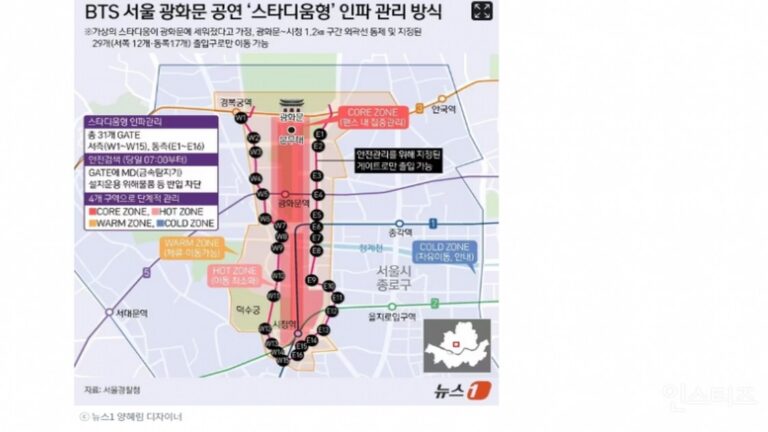
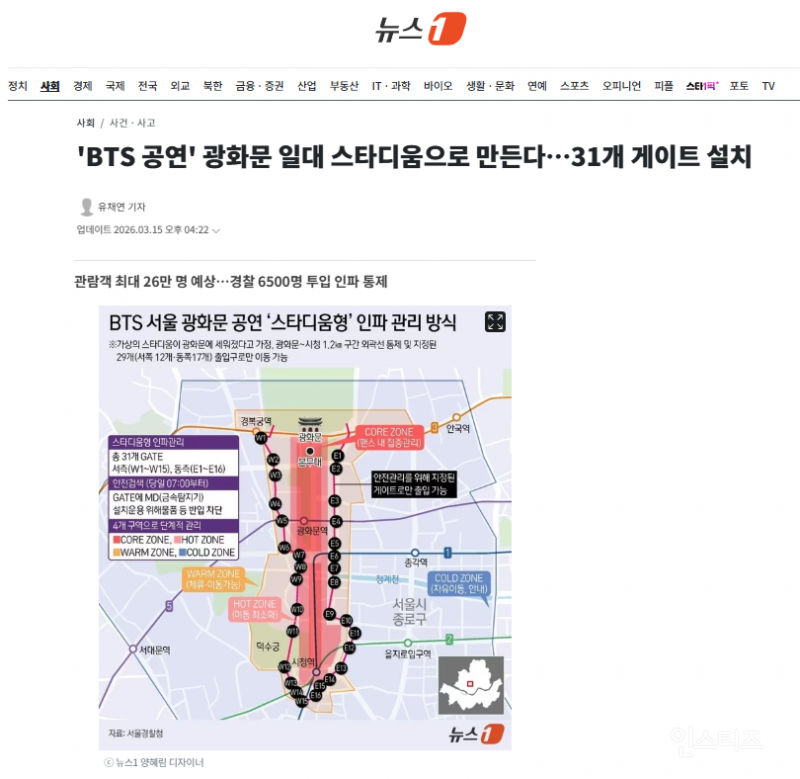
The Seoul Metropolitan Police Agency has finalized an unprecedented security protocol for the upcoming BTS performance at Gwanghwamun Square, scheduled for March 21, 2026. In a move that signals the massive scale of the group’s 2026 activities, authorities will transform the heart of the capital into a temporary controlled venue using a “stadium-style” crowd management system. This strategy represents the most significant mobilization of public safety resources for a cultural event in the current decade, aiming to regulate an expected influx of over 260,000 attendees.
Unprecedented Security Measures for Landmark Performance
According to an official statement released by the Seoul Metropolitan Police on March 15, the area surrounding Gwanghwamun Square and Sejong-daero will be completely enclosed using high-strength fencing. This perimeter is designed to replicate the entry and exit controls of a professional sports stadium. Unlike previous open-air festivals where crowds could flow freely from side streets, this event will restrict access to 31 designated gates. Each gate will serve as a checkpoint to monitor density levels in real-time and prevent the dangerous overcrowding that can occur in unrestricted urban spaces.
Police representatives confirmed that the decision to implement such a rigid structure stems from the sheer volume of anticipated fans. With 260,000 people expected to converge on the district, the traditional methods of simple barricading were deemed insufficient. By treating the public square as a stadium, security personnel can effectively “pulse” the crowd, slowing down entry when specific sectors reach capacity. This sectoral management is a direct response to modern safety standards for large-scale gatherings in major metropolitan hubs.
“I work in an office building right next to the Square, and the logistics look intense. 31 gates mean they are basically sealing off the entire Sejong-daero corridor. I’m already planning my detour for the weekend because 260,000 people is essentially a small city moving into one intersection.” — Anonymous user on local community board Instiz
The Logistics of a ‘City Center Stadium’
Transforming Gwanghwamun into a controlled environment involves more than just fences. The 31 gates will be equipped with counting mechanisms to provide the command center with precise data every minute. If one sector of the square becomes too dense, gates leading to that specific area will be temporarily diverted. This granular level of control is rarely seen outside of ticketed venues, but the Seoul Metropolitan Police Agency indicated that the global profile of BTS and the potential for spontaneous crowd surges necessitated these extreme measures.
The physical layout will span from the Gwanghwamun gate down toward the Sungnyemun area, covering several blocks of Sejong-daero. Traffic will be entirely redirected starting from the early hours of March 21. Pedestrian movement for non-concertgoers will also be heavily restricted, with police advising citizens to avoid the central district unless they have a specific need to be there. Local businesses have been briefed on the security perimeter, though many express concerns regarding the total closure of the main thoroughfare.
Massive Deployment: 6,500 Personnel and Specialized Equipment
The scale of the manpower being deployed is equally staggering. The Seoul Metropolitan Police Agency will mobilize 70 riot police units (기동대), alongside specialized personnel from the traffic division, criminal investigation units, and the elite police tactical units (특공대). In total, approximately 6,500 officers will be on-site. This represents one of the largest single-day deployments for a non-political event in Seoul’s history, highlighting the gravity with which the city is treating the security of this comeback-era performance.
In addition to human personnel, the police are deploying 5,400 pieces of specialized safety equipment. This includes high-altitude observation vehicles that provide a bird’s-eye view of crowd movements, broadcast lighting trucks to ensure visibility in the evening hours, and modular folding fences that can be quickly redeployed if a breach occurs. The use of high-altitude observation is particularly critical, as it allows the central command to identify “choke points” before they become hazardous to the public.

“6,500 officers is a massive number. To put that in perspective, that is more than the entire police force of some mid-sized cities. They are clearly prioritizing zero-accident safety over everything else for this BTS show.” — Security Analyst via News1 Korea
Public Safety and Transportation Impact
Commuters and local employees are expected to face significant disruptions. Since the performance falls on a Saturday, the police have issued a preemptive warning for those who work in the Jongno and Jung-gu districts. Public transportation, particularly the Seoul Subway Line 5 (Gwanghwamun Station) and Line 1/2 (City Hall Station), will likely operate under special conditions. There is a high probability that trains may bypass Gwanghwamun Station if platform overcrowding exceeds safety limits, a standard procedure for major events at this location.
Bus routes that normally traverse Sejong-daero will be rerouted to Uiju-ro or Namdaemun-ro. The police department has requested cooperation from the Seoul City Government to increase the frequency of subway trains and late-night buses on surrounding lines to facilitate the dispersal of the 260,000 attendees once the event concludes. Dispersal is often the most dangerous phase of large gatherings, and the police plan to release the crowd in staggered waves through the 31 gates to prevent a rush toward the subway entrances.
Global Interest and Fan Expectations
The international community has turned its eyes toward Seoul for this event, which serves as a pivotal moment in BTS’s 2026 schedule. While the agency, HYBE, has kept specific setlist details under wraps, the scale of the police preparation suggests a performance of historic proportions. Fan communities on platforms like Weverse and X (formerly Twitter) have been sharing the police’s security maps to ensure that those attending are aware of the gate system. International fans traveling to Korea have been advised to arrive at their designated gate sectors early, as security screenings are expected to be rigorous.
The sheer number of 260,000 expected attendees is a testament to the group’s enduring influence following their full-group return. Security experts note that Gwanghwamun has always been a symbolic location for Korean public life, and hosting a BTS performance there with stadium-level security further elevates the event from a mere concert to a national cultural milestone. The police have emphasized that their primary goal is to ensure that the global spotlight remains on the performance rather than any safety incidents.
“I’m flying in from Tokyo for this, and seeing the police maps actually makes me feel safer. After everything we’ve seen with crowd safety in recent years, knowing there are 31 gates and 6,500 officers makes me feel like I can just focus on the music.” — International fan on social media
A New Standard for Urban Crowd Management
The “stadium-style” approach at Gwanghwamun may set a new precedent for how major cities handle massive, non-ticketed events in the future. By applying the physics of a closed venue to an open urban square, the Seoul Police are attempting to solve the inherent unpredictability of street-level gatherings. If successful, this model could be adopted for future festivals, parades, and celebrations across South Korea. The integration of high-tech observation with a massive ground presence represents a sophisticated evolution in public order maintenance.
As of March 16, 2026, the installation of the perimeter fences has already begun in certain sections of the square. The police have established a temporary command center on-site to oversee the final preparations over the next five days. They have reiterated that anyone attempting to enter the zone through unauthorized areas will be strictly redirected to the 31 official gates. The agency has also coordinated with emergency medical services to station ambulances and first-aid tents at regular intervals along the perimeter.
No further updates regarding additional guest performers or specific road closure times have been released at this hour. However, the Seoul Metropolitan Police Agency has promised to provide real-time traffic and crowd density updates via their official social media channels throughout the day of the event. SYNC SEOUL will continue to monitor the situation as the March 21 performance approaches.
The combination of meticulous police planning and the high-stakes return of BTS to a major public stage ensures that this event will be remembered not just for its music, but for its logistical complexity. Fans are encouraged to follow all official directives and use the designated gate system to ensure a safe experience for all 260,000 participants.