


The Tea is Scalding: A Royal Mess in Tokyo
So… my little birds in Tokyo have been busy, and let me tell you, the tea is absolutely SCALDING today 🍵. While the rest of the world is focusing on home runs and pitching rotations for the 2026 World Baseball Classic (WBC), one player has managed to strike out with an entire nation without even picking up a bat. We’re talking about the Chicago White Sox’s very own Munetaka Murakami, and honestly? The vibe in Japan right now is beyond tense. It’s not just a sports controversy; it’s a full-blown cultural war that has the internet divided into two very angry camps.
Imagine the scene: March 8, 2026. The high-stakes matchup between Japan and Australia has just concluded. The energy in the stadium is electric, but the real drama started when the game ended. As is tradition for such prestigious events, the Japanese Imperial family was in attendance. We’re talking the Emperor, the Empress, and Princess Aiko. As they prepared to make their exit, the entire Japanese roster stood in a line, bowing and clapping in a display of peak national etiquette. Everyone, that is, except for Murakami. While his teammates were showing the utmost respect, the MLB star was caught on camera with his arms crossed, leaning back, and—wait for it—casually chewing gum like he was waiting for a bus in downtown Chicago. Let’s just say the optics were… not great.
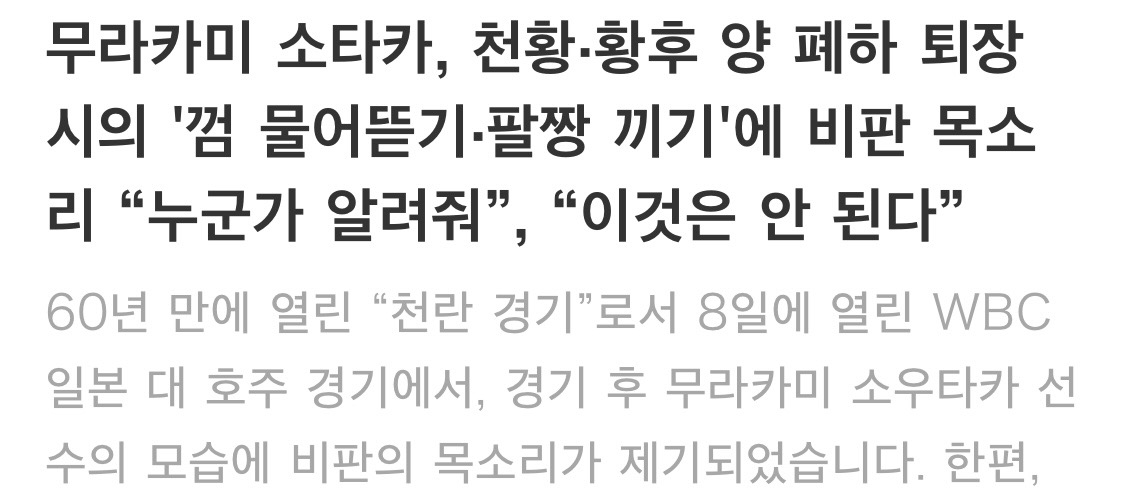
Social media didn’t wait a single second to pounce. Within minutes of the broadcast, clips of the “snub” were circulating on X (formerly Twitter) and Japanese community boards like TheQoo. The backlash was instantaneous and visceral. In a country where social harmony and respect for the Imperial institution are deeply ingrained, Murakami’s casual posture felt like a slap in the face to many. Critics are calling him everything from “unprofessional” to “anti-Japanese.” It’s the kind of scandal that transcends sports and hits right at the heart of national identity, and the comments are going absolutely INSANE.
The Weight of the Imperial Presence
To understand why people are losing their minds, you have to understand the context of the 2026 WBC. This isn’t just a tournament; it’s a moment of massive national pride for Japan. Having the Emperor, Empress, and Princess Aiko attend the game against Australia was a sign of the event’s importance. In Japanese culture, the concept of ‘fukei’ (irreverence) toward the Imperial family is a massive taboo. Even if you aren’t a monarchist, there is a standard level of public decorum expected when the royals are present. By standing there with his arms crossed and gum moving in his jaw, Murakami didn’t just look bored—he looked defiant. Or at least, that’s how the public is interpreting it.
“I honestly couldn’t believe my eyes. Everyone else is showing basic human decency and respect to the symbols of our nation, and he’s just standing there like he’s too cool for school. It’s embarrassing for the whole team.” – A viral post on X with 50k+ likes
The timing couldn’t be worse for Murakami. He’s currently one of Japan’s biggest exports to the MLB, playing for the Chicago White Sox. There’s always a bit of a “prodigal son” narrative when these players come back for the WBC. Fans expect them to bring that American power but keep their Japanese heart. Instead, Murakami appeared to have brought back an American sense of individualism that didn’t sit well with the home crowd. Some are even speculating that his time in the U.S. has “corrupted” his sense of Japanese etiquette, leading to the “anti-Japanese” labels being thrown around in the darker corners of the internet.
The “Gum-Gate” Backlash: Anti-Japanese or Just Bored?
The vitriol being leveled at Murakami is staggering. On platforms like TheQoo, threads about the incident have racked up tens of thousands of views in a matter of hours. The most common sentiment? That he has become “too big for his boots.” There’s a sense that because he’s a multi-million dollar MLB star, he feels he’s above the traditional rules that govern everyone else. Terms like “arrogant” and “disgraceful” are being used in almost every other comment. It’s a classic case of a public figure failing the “vibe check” on a massive, televised scale.
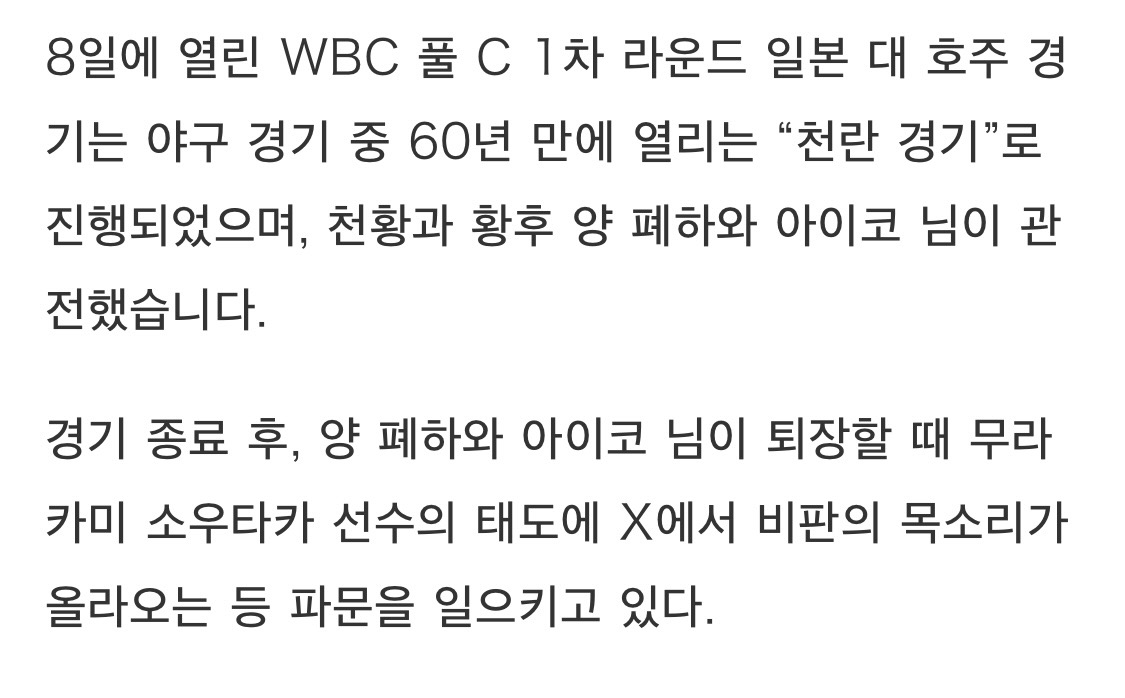
However, it’s not just about the gum. The crossed arms are what really set people off. In Japanese body language, crossing your arms while someone of higher status is speaking or passing by is often seen as a defensive or even hostile gesture. It signals a closed-off attitude. When you contrast that with the rest of the Samurai Japan team—who were literally leaning forward in their enthusiasm to show respect—Murakami sticks out like a sore thumb. He looked like the one kid in class who refuses to stand up for the national anthem, and in the high-pressure environment of the WBC, that’s a dangerous game to play.
“Is he actually anti-Japanese? Or does he just hate being there? If you don’t want to represent the country with respect, stay in Chicago. We don’t need this kind of attitude in the national dugout.” – Top comment on a Japanese sports forum
The Minority Report: Is Japan Turning into North Korea?
Now, I’m all about showing both sides of the coin, and there is a small but vocal minority that thinks this whole thing is being blown way out of proportion. These defenders argue that the reaction to Murakami is bordering on nationalistic hysteria. They point out that he’s an athlete, not a politician or a diplomat. He just finished a grueling game, he was likely exhausted, and maybe—just maybe—he was simply in the zone and didn’t realize the cameras were zooming in on his every facial twitch. To these fans, the demand for total, uniform submission to the Imperial family feels a bit too much like authoritarianism.
Some commenters have even gone as far as to compare the public outcry to the kind of forced reverence seen in North Korea. “Are we really going to crucify a man because he didn’t clap hard enough?” one user asked. “He’s there to hit home runs, not to be a puppet for the royals.” This perspective suggests that the hyper-fixation on his body language is a distraction from his performance on the field. They argue that as long as he’s helping Japan win the WBC, his personal feelings (or lack thereof) toward the monarchy should be irrelevant. But let’s be real: in the world of K-media and J-media gossip, perception is reality, and right now, the perception is that Murakami is a “rebel” without a cause.
The MLB Effect and the Cultural Divide
We have to talk about the “Americanization” factor here. Murakami moved to the Chicago White Sox with a lot of fanfare, and he’s been soaking up that Chicago energy for a while now. In the MLB, chewing gum and having a bit of an attitude is part of the brand. It’s expected. You want your power hitters to be a little bit cocky. But that “main character energy” doesn’t always translate when you’re back on home soil representing the national team. There’s a delicate balance that players like Ohtani have mastered—being a global superstar while remaining humble and traditionally respectful. Murakami, it seems, missed the memo on that balance.
“This is what happens when you spend too much time in the West. You forget where you came from. Ohtani would never do this. Darvish would never do this. It’s a matter of character, not just talent.” – Community board reaction
This incident has opened up a much larger conversation about what we expect from our modern idols. Do we want them to be perfect avatars of traditional values, or do we allow them the space to be individuals? In 2026, you’d think we’d be more relaxed, but if anything, the internet has made us more sensitive to these small gestures. Every frame of video is analyzed, every expression is memed, and every mistake is magnified a thousand times. Murakami is currently learning that the hard way. He might be a king in Chicago, but in Tokyo, there’s only one Imperial family, and you better clap when they walk by.
Sua’s Final Sip: My Hot Take
Okay, let’s get into it. Do I think Murakami meant to start a national scandal? Probably not. He was likely just tired and caught in a moment of mindless habit. We’ve all been there—standing somewhere we don’t want to be, chewing gum, and wishing we could just go home. But—and it’s a BIG but—he’s a professional. He knows the cameras are on him. He knows the cultural weight of the Imperial family. To be that careless in such a high-profile moment is, at best, a massive PR blunder and, at worst, a sign of genuine arrogance. You can’t just ‘turn off’ your Japanese identity when it’s convenient and then expect the fans to stay loyal when you’re acting like a tourist in your own country.
The “anti-Japanese” labels are definitely a stretch—let’s not get carried away, people—but the criticism regarding his lack of professionalism is valid. When you wear the national jersey, you’re representing more than just your batting average. You’re representing a culture. If he wants to avoid being the villain of the 2026 WBC, he needs to issue a statement, and he needs to do it fast. A simple “I was exhausted and didn’t mean any disrespect” would go a long way. But knowing how these things go, he might just try to power through it. Stay tuned, because if he strikes out in the next game, the fans are going to eat him alive. The tea is still brewing on this one, and I’ll be here to pour every drop. 👀🍵
What Happens Next?
As of right now, neither Murakami’s camp nor the Japan National Team has released an official statement. This is a classic “wait and see” move. If the noise dies down, they’ll ignore it. If the sponsors start getting twitchy? Expect a very formal, very deep bow of an apology in a press conference soon. The WBC is a long tournament, and Murakami has plenty of time to redeem himself on the field, but the court of public opinion is much harder to win over than a baseball game. The Japanese public has a long memory for these kinds of things.
Will this affect his standing with the Chicago White Sox? Unlikely. The MLB cares about stats, not whether or not you clapped for a royal family 7,000 miles away. But for his brand deals back home in Japan? This could be a nightmare. Companies don’t want their products associated with someone labeled as “disrespectful” or “anti-patriotic.” We could see some of those lucrative Japanese endorsement deals start to evaporate if he doesn’t handle this with some grace. It’s a high-stakes game of PR chess, and Murakami just lost his queen.
Keep your eyes on the next game’s post-match ceremonies. You can bet every camera in the stadium will be glued to Murakami to see if he’s learned his lesson. Will he be the first one clapping? Or will he double down on the “cool guy” persona? Either way, SYNC SEOUL will be watching. This is exactly the kind of drama that makes the WBC more than just a game. It’s a soap opera on grass, and I am here for every single episode. Stay thirsty, my friends. 🤫
—
*This article contains unconfirmed reports and should be treated as rumor until officially confirmed. SYNC SEOUL does not make claims about the personal lives of celebrities beyond what is reported by credible sources.*