



Project Hail Mary’ IMAX Premiere: Weir’s Sci-Fi Masterpiece?
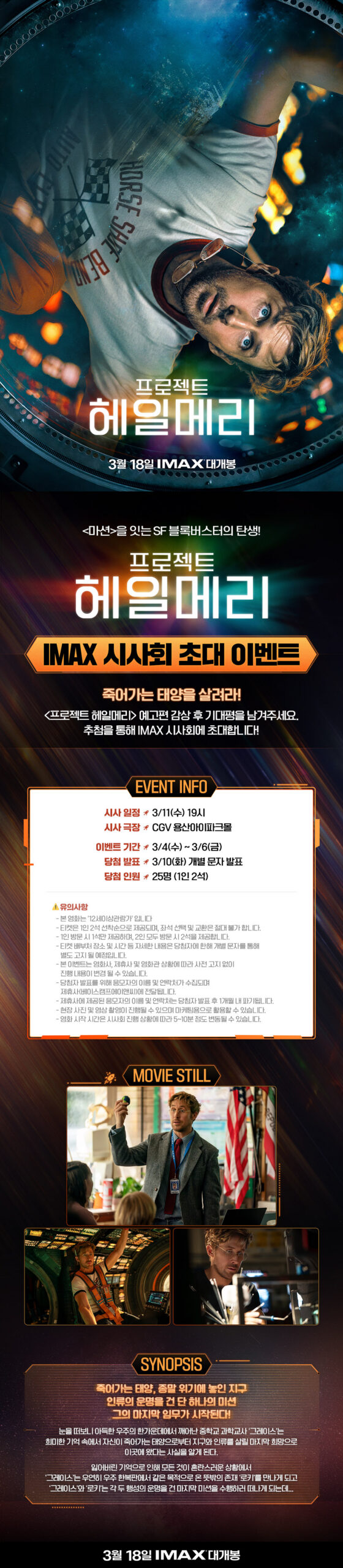
The cosmic hum of anticipation is growing louder, and SYNC SEOUL is right there, ears to the ground, or rather, eyes to the screen. Andy Weir’s latest literary sensation, Project Hail Mary, is poised to make its grand cinematic debut, and the buzz around its exclusive IMAX premiere event at CGV Yongsan I’Park Mall is nothing short of astronomical. Scheduled for March 11, 2026, this isn’t just a movie screening; it’s a statement, a declaration that this film demands the largest canvas possible. For a critic, a pre-release IMAX viewing is a rare privilege, offering the purest form of the director’s vision before the wider world gets its hands on it.
Weir, the mastermind behind the beloved The Martian, has a knack for blending rigorous scientific accuracy with a compelling, often humorous, human narrative. Project Hail Mary follows an astronaut who wakes up on a spaceship with no memory of who he is or how he got there, only to discover he’s humanity’s last hope to save a dying sun. It’s a premise ripe for cinematic exploration, promising existential dread, ingenious problem-solving, and perhaps, a touch of that signature Weir wit. The question, of course, is whether the film can truly capture the intricate magic of the novel. My initial impressions, gleaned from the tantalizing trailer and the sheer weight of expectation, lean towards a cautious but distinct optimism.
The Weight of the Cosmos: Trailer’s First Impressions
Cinematically speaking, the trailer for Project Hail Mary is a masterclass in establishing tone and scale without giving away too much. The initial shots of the vast, silent emptiness of space immediately set a mood of profound isolation. The color grading, a consistent palette of deep blues and blacks punctuated by the stark white of the spacecraft’s interior, effectively communicates the cold, unforgiving nature of the cosmos. There’s a deliberate slowness in the early cuts, allowing the viewer to absorb the sheer magnitude of the protagonist’s predicament before the pace quickens with glimpses of alien landscapes and high-stakes scientific endeavors. It’s a promise of visual storytelling that prioritizes immersion over frenetic action, a choice I deeply appreciate in the sci-fi genre.
What truly elevates the trailer, however, is its subtle suggestion of the emotional journey. While Weir’s books are often celebrated for their intellectual puzzles, they also contain deeply human characters. The framing of the astronaut, often alone in the center of the frame, emphasizes his solitude and the immense burden he carries. The fleeting shots of his face, etched with confusion and determination, hint at a performance that will need to navigate both intellectual curiosity and profound vulnerability. This balance is crucial; a sci-fi film, however grand its scope, falters if it loses sight of the human element at its core. The trailer suggests a director keenly aware of this delicate equilibrium.
“Honestly, after watching the trailer, I’m convinced this needs to be seen on the biggest screen possible. The scale they’re hinting at is insane. IMAX is the only way to do this story justice. My body is ready for this space epic!” – @StardustDreamer17
Andy Weir’s Signature: Writing the Impossible
Andy Weir’s literary prowess lies in making complex scientific concepts not just understandable, but exciting. His books read like thrilling textbooks, where the protagonist’s survival hinges on their ability to perform intricate calculations and ingenious engineering feats. The challenge for any adaptation of Weir’s work, particularly Project Hail Mary, is translating this internal monologue of scientific problem-solving into compelling visual and verbal exposition without resorting to tedious lectures. The writing in the film will need to maintain the novel’s meticulous detail while streamlining it for a broader audience, a feat that requires a delicate touch. The dialogue, I hope, retains Weir’s characteristic blend of dry wit and earnest determination, which grounds even the most outlandish scenarios.
Comparing it to The Martian, which successfully translated its protagonist’s resourceful isolation to the screen, Project Hail Mary presents an even greater narrative hurdle: the amnesia plotline and the introduction of a truly alien entity. The writing will have to meticulously peel back layers of memory while concurrently building a relationship with a non-human character, all while the clock ticks down on humanity’s existence. This layered narrative demands a tightly structured script that avoids deus ex machina moments and instead earns its resolutions through logical, if improbable, scientific breakthroughs. The writing falters when it sacrifices ingenuity for convenience, and I have high hopes that Weir’s influence, or at least the spirit of his work, will keep the narrative on its rigorous path.
Casting the Lone Astronaut: Performance Expectations
The central performance in Project Hail Mary is arguably the make-or-break element of the entire film. The lead actor, whose name is still under wraps but has been the subject of fervent speculation across online communities, will need to deliver a performance that is both intellectually commanding and deeply empathetic. This isn’t just about reciting scientific jargon convincingly; it’s about conveying the crushing weight of responsibility, the isolation of being the last hope, and the existential terror of a forgotten past. The actor must carry a significant portion of the film alone, relying on subtle facial expressions, vocal inflections, and physical presence to communicate a vast inner world.
What elevates this kind of role is the ability to project an internal monologue externally, making the audience privy to the character’s thought process without constant voiceovers. Think of the nuanced performances in films like Gravity or Moon – actors who can hold the screen with their sheer presence and the depth of their emotional portrayal. Chemistry, in this context, won’t be with a human co-star for much of the film, but rather with the challenges of space, the scientific puzzles, and ultimately, with an unlikely companion whose nature I won’t spoil for those unfamiliar with the book. This demands a versatile actor capable of both stoic determination and moments of raw vulnerability. It’s a masterclass in solo acting, if done right.
“I just hope they cast someone who can pull off the blend of genius and slightly awkward humor that Ryland Grace has in the book. It’s such a specific vibe. If they get the casting wrong, the whole movie could fall flat, no matter how good the visuals are.” – @BookwormGalaxy
Production Design: Crafting the Future of Space Travel
A film of this ambition lives or dies by its production design. From the intricate machinery of the ‘Hail Mary’ ship to the depiction of alien environments and the very concept of a dying sun, every visual element must be meticulously crafted. The importance of realistic (yet cinematic) spacecraft design cannot be overstated; it needs to feel functional, lived-in, and capable of interstellar travel without veering into overly fantastical territory. The mise-en-scène here will be crucial in conveying the advanced technology and the vastness of the journey. I’m particularly keen to see how they render the unique alien world and its inhabitants, a significant departure from the more terrestrial settings of The Martian.
The CGI quality, especially for depicting the astronomical phenomena and the intricacies of space travel, will be under intense scrutiny. In an age where audiences are accustomed to photorealistic visual effects, anything less than exceptional will detract from the immersive experience. The budget use here must be strategic, ensuring that the spectacle serves the story rather than overwhelming it. The director’s choice to screen in IMAX indicates a confidence in the visual fidelity, suggesting that every detail, from the smallest bolt on the spaceship to the grandest cosmic anomaly, has been considered to fill that massive screen. This is a film that promises to transport you, and the production design is the vehicle for that journey.
“The production design looks incredible from the trailer. Everything feels so tangible, not just green screen. And if they really commit to the book’s description of *that* alien, it’s going to be wild. This is why we need big screen sci-fi!” – @SciFiNerd_KOR
The Verdict (Pre-Release): A Promising Odyssey?
Based on the event information, the captivating trailer, and the sterling reputation of its source material, Project Hail Mary holds the potential to be a truly significant entry into the sci-fi canon of 2026. The exclusive IMAX premiere is not just a promotional stunt; it’s a strategic choice that speaks to the film’s visual ambition and its creators’ belief in its immersive power. My initial impression is that this could very well be a cinematic triumph, offering both intellectual stimulation and profound emotional resonance, a rare combination in modern blockbusters.
Unpopular opinion, but I worry slightly about the pacing. Weir’s books are dense with scientific explanations, and while fascinating on paper, translating that into dynamic screen time without losing momentum can be challenging. The writing falters when it over-explains, and the direction will need to find elegant visual shortcuts for exposition. However, if the film manages to maintain the novel’s core spirit – its blend of scientific wonder, human ingenuity, and unexpected companionship – then it will undoubtedly be worth the journey. This is a film for those who yearn for thoughtful science fiction, for stories that challenge the mind as much as they stir the heart.
The anticipation among fans is palpable, with comments on the event page reflecting a mix of excitement and high expectations. Many are eager to see if the film can live up to the book’s legacy, especially given the success of The Martian. The unique viewing experience promised by IMAX is clearly a major draw, adding another layer to the already intense buzz. It’s clear that Project Hail Mary isn’t just a movie; it’s an event.
“I loved the book so much, I’m nervous but also SO excited for this movie! If they get the tone right, it’s going to be unforgettable. The IMAX screening is a dream come true for a fan like me.” – @CosmicReader
“Finally, a proper hard sci-fi movie! No nonsense, just pure scientific problem-solving with high stakes. And in IMAX? Sign me up twice. This is exactly what the big screen was made for.” – @LogicLover77
So, is Project Hail Mary destined to be a sci-fi masterpiece? All signs point to a resounding ‘maybe,’ with a strong emphasis on the ‘yes.’ The exclusive IMAX premiere on March 11, 2026, at CGV Yongsan I’Park Mall offers a tantalizing glimpse into what could be one of the year’s most compelling cinematic odysseys. For fans of intelligent storytelling and breathtaking visuals, this is one voyage you won’t want to miss. Prepare for launch.