


The Viral Clip That Split the Internet
Early this morning, the K-drama community found itself embroiled in a fascinating debate that had nothing to do with plot holes or PPL. Instead, the focus was entirely on the vocal cords of actress Cha Joo-young. A post on the popular community site TheQoo, titled “Cha Joo-young seems to have caught a unique dialogue tone in her recent work,” quickly racked up over 23,000 views and 265 comments in just a few hours. The source of the commotion? Three viral clips from X (formerly Twitter) showcasing her latest performance, where her delivery is—to put it mildly—unlike anything we’ve heard from her before.
Watching the clips, it’s immediately apparent why the internet is divided. One side of the gallery finds her new cadence “charming and addictive,” while the other argues that her “dialogue tone stands out too much alone,” effectively pulling them out of the story. It is a classic case of experimental acting hitting the mainstream wall. As a critic, I find this friction exhilarating. In an industry that often rewards the “safe” choice of naturalism, seeing an actress of Cha’s caliber take a massive swing with her vocal characterization is exactly the kind of disruption we need. Whether it actually works within the frame of the drama, however, is a much more complex question.
“It’s like she’s in a different genre entirely, but somehow it works? I can’t stop rewatching that one line delivery. It’s definitely an acquired taste, but once you get it, you’re hooked.” — TheQoo User, ID: 102
A Masterclass in Vocal Texturing?
Cinematically speaking, the voice is just as much a tool as lighting or camera angles. Cha Joo-young seems to have realized this, moving away from the sharp, biting clarity she utilized so effectively in The Glory. In her current role, she employs a stylized, almost rhythmic cadence. There’s a breathiness in her mid-range that she suddenly clips with staccato endings. It’s theatrical, yes, but it’s also deeply intentional. She isn’t just reciting lines; she’s constructing a sonic identity for her character that feels separate from her own persona. This isn’t a mistake; it’s a choice, and in my book, a choice is always better than a lack thereof.
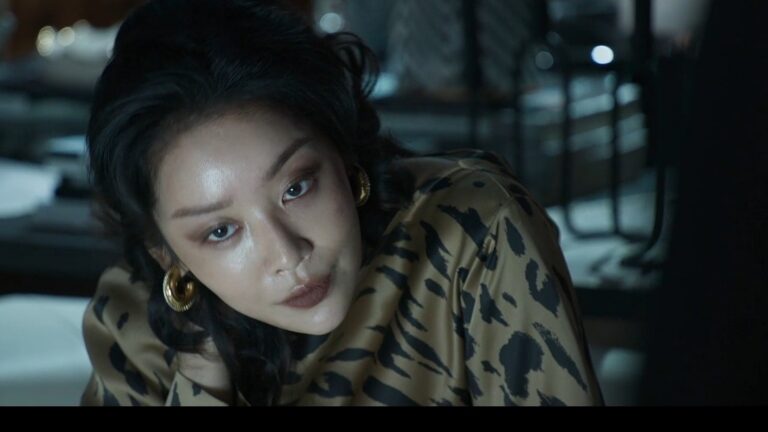
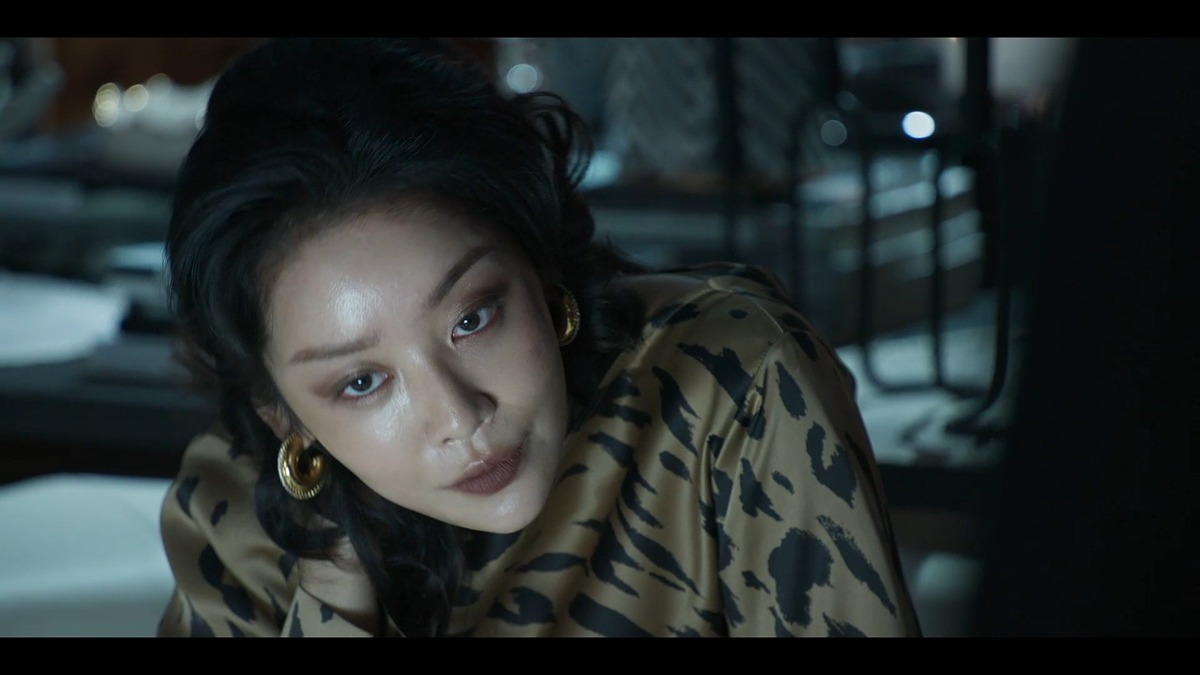
What elevates this scene analysis is how her tone interacts with the mise-en-scène. In the second viral clip, where she’s framed in a tight close-up against a cold, industrial background, that whisper-thin delivery creates a haunting dissonance. It makes the character feel fragile yet dangerous, like glass that’s already cracked but hasn’t shattered. If she had delivered those same lines in a standard, melodic K-drama heroine voice, the tension would have evaporated. The director’s choice to let her run with this experimentation suggests a high level of trust in her craft, allowing the performance to dictate the mood rather than the music cues.
The “Immersion Break” Argument
Unpopular opinion, but I understand why some viewers are reaching for the remote. When an actor’s delivery is so distinct that it becomes the primary thing you notice, it risks overshadowing the narrative. The criticism that her tone “stands out too much alone” isn’t entirely baseless. In scenes where she shares the screen with actors who favor a more grounded, naturalistic style, the contrast can be jarring. It’s like watching a Shakespearean actor suddenly walk onto the set of a slice-of-life indie film. The frequencies don’t always align, and for a viewer looking for a seamless reality, that gap is where immersion goes to die.
Some comments on the TheQoo post pointed out that while they eventually “melted into” the performance, the initial shock was a barrier. This raises a valid point about the pacing of character introduction. If a performance is this stylized, the script and direction need to work overtime to justify it within the first ten minutes. If the world-building doesn’t support the eccentricity of the voice, the actor is left hanging out to dry. In this latest project, the writing falters slightly in its support of Cha’s bold choices, leaving her to carry the weight of the character’s “uniqueness” entirely on her vocal cords.
“I tried to focus on the plot, but her voice is so distinct it pulls me out of the scene. It feels like she’s ‘acting’ too hard compared to everyone else in the room.” — TheQoo User, ID: 88
Tracing the Trajectory: From ‘The Glory’ to Experimentalism
To understand why Cha Joo-young is taking these risks, we have to look back at her career arc. After her breakout as Choi Hye-jeong, she could have easily coasted on playing variations of the ‘glamorous villainess.’ But Cha has consistently pushed against being pigeonholed. She’s an actress who clearly values the ‘process’ over the ‘product.’ This latest vocal experiment feels like a natural evolution for someone who has already mastered the basics of screen presence and is now looking to dismantle and rebuild her toolkit. It reminds me of how veteran actors like Kim Hye-soo or Lee Jung-jae often pivot to extreme characterizations later in their careers just to keep the spark alive.
Analysis of her previous roles shows a steady progression toward this moment. In her recent projects, we already saw her playing with pitch and silence in ways that her peers weren’t. She’s moving away from the ‘pretty’ delivery that the industry often demands of actresses and toward something more visceral and, frankly, more interesting. Even if this specific tone doesn’t land for everyone, the fact that she’s willing to be ‘ugly’ or ‘weird’ with her voice is a masterclass in artistic bravery. She’s trading likability for memorability, a trade that critics usually applaud even if the general public is hesitant.
The Director’s Hand: Intentional Stylization or Lack of Guidance?
We often lay the praise or blame for a performance solely at the feet of the actor, but the director’s role in this ‘tone debate’ cannot be ignored. Did the director encourage this specific cadence to highlight the character’s mental state? Or was it a case of an actor’s experiment being left unchecked in the editing room? Looking at the way the shots are paced—often lingering on Cha’s face long after she’s finished speaking—it feels highly intentional. The editing gives her the space to let those strange, clipped vowels hang in the air, suggesting that the production team was fully on board with this ‘addictive’ quality fans are mentioning.
However, a masterclass in direction would have ensured that the rest of the cast was ‘playing in the same key.’ The reason some viewers find her tone distracting is likely because the ensemble isn’t harmonized. When one instrument is playing jazz while the rest of the orchestra is stuck on a classical score, the jazz player looks like they’re making mistakes. If the director wanted this stylized world, they should have pushed the other actors to meet Cha at her level of artifice. Instead, we’re left with a performance that is brilliant in a vacuum but occasionally discordant in context.
“At first, I thought she was just nervous, but then I realized every single word is calculated. It’s addictive because you never know how she’s going to end a sentence.” — TheQoo User, ID: 214
The Evolving Landscape: Why “Safe” Acting is Dying
As the K-drama landscape becomes increasingly crowded, with global platforms demanding more ‘edge’ and local audiences becoming more sophisticated, the standard ‘clean’ acting of previous years is no longer enough to generate buzz. Cha Joo-young’s vocal experiment is a symptom of this shift. Actors are realizing that to stand out in a sea of content, they have to take creative risks that might alienate a segment of the audience. The fact that a 23,000-view thread exists solely to discuss her voice is proof that her strategy is working. She is the conversation.
This trend toward ‘high-concept’ acting is something I’ve been tracking for months. We’re seeing a move toward the theatrical, the grotesque, and the hyper-stylized. Cha isn’t just following a trend; she’s at the forefront of it. By focusing on the minutiae of her delivery, she’s forcing the audience to pay closer attention, to listen instead of just hearing. It’s a bold move in an age of second-screen viewing where many people watch dramas while scrolling through their phones. You cannot multi-task while watching Cha Joo-young in this role; her voice demands your full cognitive load.
Final Verdict: A Risky Bet That Pays Off
So, is Cha Joo-young’s new acting tone a stroke of genius or a distracting misfire? My verdict leans heavily toward the former, with a small caveat for the production’s overall cohesion. While it may be jarring for those used to the invisible acting style of traditional melodramas, Cha’s work here is a reminder that acting is an art form, not just a service. She is manipulating the medium, using her voice to create a texture that stays with you long after the episode ends. It is ‘addictive’ precisely because it is ‘different.’
For those who find it distracting, I suggest watching the clips again through the lens of character psychology. Ask yourself: why would a person speak this way? What are they trying to hide? What are they trying to control? When you stop looking for ‘normal’ and start looking for ‘truth,’ Cha’s performance opens up in a way that is incredibly rewarding. She delivers a performance that is technically demanding and emotionally resonant, even if the frequency she’s broadcasting on is one that some viewers haven’t tuned into yet. This is the kind of work that wins awards and stays in the archives of film studies. It’s not just acting; it’s a statement.
“I’d rather watch an actress try something new and fail than watch the same ‘perfect’ performance for the hundredth time. But the thing is, I don’t think she’s failing.” — TheQoo User, ID: 45
Ultimately, Cha Joo-young has proven once again that she is one of the most exciting talents of her generation. She isn’t afraid to be the subject of a divided forum thread, and she isn’t afraid to let her craft stand out, even if it stands alone. In the grand scheme of things, a bit of ‘immersion break’ is a small price to pay for a performance that actually makes us stop and think about the mechanics of storytelling. Whether you love it or hate it, you’re talking about it—and that is the ultimate win for any artist.