



The Audacious Return of the Makjang Queen
Cinematically speaking, we often talk about the ‘magic’ of chemistry between leads. We attribute it to natural talent, a spark on set, or perhaps the intuitive guidance of a veteran director. But leave it to Im Sung-han—the polarizing architect of K-drama’s most surreal hits—to turn that magic into a grueling, industrial manufacturing process. As of March 2026, the industry is buzzing with the latest revelation from her upcoming production. We aren’t just talking about a standard table read or a few chemistry workshops. No, Im Sung-han has reportedly subjected her five leads to a three-month, ten-hour-a-day ‘idol-style’ boot camp. It is a move that feels less like traditional television production and more like a psychological endurance test.
Unpopular opinion, but perhaps this is exactly what the industry needs to shake off its current lethargy. We’ve seen too many ‘big-budget’ dramas lately where the leads look like they met five minutes before the cameras rolled. Im Sung-han, ever the eccentric auteur, seems determined to ensure that by the time the first ‘Action!’ is called, her cast isn’t just acting—they are synchronized. This isn’t just about memorizing lines; it’s about the mise-en-scène of human interaction. When you spend 900 hours in a room with four other people practicing the same beats, the resulting performance is bound to be something different than what we usually see on tvN or JTBC. Whether that ‘something’ is brilliant or merely mechanical remains the million-dollar question.
Breaking Down the 10-Hour Daily Grind
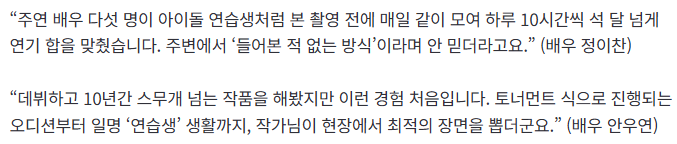
The sheer scale of this training regimen is unprecedented in the drama world. According to reports surfacing today, March 14, 2026, the five leads—Jung Yi-chan, Chun Young-min, Baek Seo-ra, Joo Se-bin, and Ahn Woo-yeon—were treated less like actors and more like trainees in a K-pop survival show. Ten hours a day. Every single day. For over ninety days. In a typical production, actors might meet for a handful of readings and then work on their own with acting coaches. Im Sung-han has discarded this decentralized approach in favor of a centralized, rigorous collective. They are reportedly practicing their ‘acting synergy’ in a way that mimics choreography.
“Wait, are they training for a drama or a world tour? 10 hours of acting sounds like a psychological experiment. I can barely focus on a movie for two hours, let alone act for ten.” — User ‘K-DramaLover99’ on Theqoo
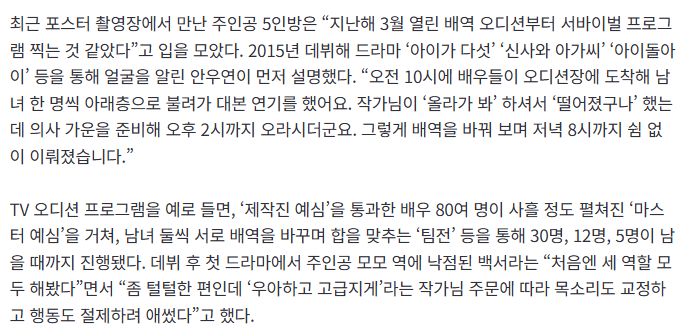
Startling details have emerged about the nature of these sessions. It wasn’t just about the script. Reports suggest the training included ‘Master Preliminaries’ and ‘Team Battles,’ terms we usually associate with Mnet’s survival programs like Produce 101 or Street Woman Fighter. Imagine being a professional actor and having to ‘battle’ your co-star to prove you’ve mastered the emotional nuance of a specific scene. It’s a high-pressure environment that likely strips away any ego, but one has to wonder if it also strips away the spontaneity that makes for truly great television. The director’s choice to implement such a rigid structure suggests a desire for total control over every micro-expression and vocal inflection.
The Gamification of the Casting Couch
What elevates this story from a simple ‘hardworking cast’ narrative into something more controversial is the ‘survival’ aspect. The mention of ‘Master Preliminaries’ implies that these actors were still being evaluated long after they supposedly ‘won’ the roles. This is peak Im Sung-han. She has always been a writer who values the script above the star. Historically, she has been known to kill off main characters on a whim or write them out of the show if the performance doesn’t meet her hyper-specific standards. By framing the rehearsal period as a survival audition, she is keeping the sword of Damocles hanging over their heads. It’s a brutal way to manage a cast, but it undeniably produces a certain type of tension that works for her specific brand of ‘makjang’ storytelling.
The writing often falters in these high-concept dramas when the actors can’t keep up with the absurdity of the plot. Im Sung-han’s scripts are notorious for their bizarre twists—remember the laser-beam eyes in Dear Heaven or the random possessions in New Tales of Gisaeng? To sell those moments, an actor needs a level of conviction that borders on the religious. You can’t wink at the camera. You have to be 100% committed to the madness. A 10-hour daily boot camp is one way to brainwash—err, ‘prepare’—a cast to accept whatever narrative curveballs she throws at them. If they can survive a three-month audition, they can survive a ghost possession or a sudden amnesia arc.
Meet the Survivors: The Im-Selection
Let’s look at the ‘Chosen Five.’ The lineup consists of Jung Yi-chan, Chun Young-min, Baek Seo-ra, Joo Se-bin, and Ahn Woo-yeon. For those who follow the industry closely, these names represent a mix of rising potential and established reliability. Ahn Woo-yeon is perhaps the most recognizable, having built a solid filmography of supporting and lead roles. For him to submit to this ‘trainee’ lifestyle suggests a significant level of respect (or fear) for the Im Sung-han brand. The others, like Jung Yi-chan and Baek Seo-ra, are being positioned as the ‘next big things.’ Im Sung-han has a track record of taking virtual unknowns—like Sung Hoon or Im Soo-hyang—and turning them into household names overnight. These five actors aren’t just playing roles; they are being molded into ‘Im Sung-han actors.’
“Im Sung-han is truly on her own planet. But hey, she made Sung Hoon a star out of nowhere, so maybe there’s a method to the madness. I just hope they’re getting paid for those 10-hour days!” — User ‘DramaGhost’ on Theqoo
Chun Young-min and Joo Se-bin also bring an interesting energy to the group. In the leaked images from the training sessions, you can see the exhaustion but also a certain sharpness in their posture. They look like they’ve been through the ringer. This isn’t the soft, polished look of a Hallyu star at a press conference; this is the look of someone who has been doing ‘Team Battles’ for twelve weeks straight. From a critic’s perspective, I am fascinated to see how this ‘forced synergy’ translates to the screen. Will they move as one unit? Will their dialogue delivery have a specific, unified rhythm? It’s an experiment in collective acting that we haven’t seen on this scale in the modern era.
The Idolization of the Actor
This trend of treating actors like idol trainees is a fascinating, if slightly disturbing, evolution in K-drama production. For years, the ‘Idol-Actor’ was a term of derision, implying someone who got a role because of their fame rather than their skill. Now, we are seeing the reverse: professional actors being forced into the idol production pipeline. The ’10-hour rule’ is a staple of the K-pop trainee system, designed to create perfection through repetition. By applying this to a drama cast, the production team is essentially trying to ‘manufacture’ chemistry. It suggests a shift away from the actor as an individual artist and toward the actor as a highly-trained component of a larger machine.
One could argue that this is a response to the increasing global scrutiny of K-content. With platforms like Netflix and Disney+ pouring money into the region, the pressure to deliver ‘perfect’ products is higher than ever. But there is a fine line between ‘well-rehearsed’ and ‘soulless.’ When I analyze the mise-en-scène of a drama, I look for the human elements—the small, unscripted moments that make a scene feel alive. If every movement is practiced for 900 hours, do we lose that humanity? Im Sung-han has never been one for ‘naturalism,’ so perhaps she doesn’t care. She wants a spectacle, and a boot-camped cast is the best way to ensure that the spectacle runs on time and according to her very specific vision.

Technical Synergy or Forced Performance?
What does this mean for the cinematography and direction? Usually, a director like Kim Hee-won or Jang Young-woo (who we saw excel in Queen of Tears) uses the camera to capture the chemistry. Here, the chemistry is being built to fit the camera. If the actors have practiced their ‘team battles,’ the director can plan complex long takes and intricate blocking with the confidence that the cast won’t miss a beat. This could lead to a visually stunning drama with high production value and seamless transitions. However, there is a risk that the performance becomes ‘breathless’—leaving no room for the audience to breathe or for the characters to exist outside of their choreographed beats.
“I need a behind-the-scenes documentary of this training camp more than I need the actual drama. Imagine the drama *behind* the drama during those 10-hour sessions!” — User ‘RealityCheck’ on Theqoo
The OST drops and the dramatic zooms that are staples of the Im Sung-han style will likely be timed to perfection with this cast. Think about the pacing. In a 16-episode series, the middle-act slump is often where the energy dips. A cast that has been trained like marathon runners might be better equipped to maintain the high-octane energy required for a makjang masterpiece. They are, quite literally, in ‘fighting shape’ for the production. This level of preparation allows the writer to be even more daring with the script, knowing the actors have the stamina to handle whatever ‘Master Preliminaries’ they’ve already conquered.
The Leah Verdict: Art or Artifice?
A masterclass in discipline or a cautionary tale of industry excess? As a critic, I find myself torn. On one hand, I applaud the commitment to craft. In an era of ‘fast-food’ content, there is something respectable about spending three months just to prepare for the shoot. On the other hand, the survival-show framing feels unnecessarily cruel and reflects a broader, more systemic issue in Korean entertainment where ‘hard work’ is often a euphemism for ‘total exhaustion.’ The 29,590 views on the original Theqoo post and the nearly 200 comments suggest that the public is equally fascinated and horrified.
The final verdict will depend entirely on the first episode. If the five leads deliver performances that are transcendent, if the chemistry is so electric it burns the screen, then Im Sung-han will be hailed as a visionary who found a new way to create stars. If the performances feel stiff, over-rehearsed, or drained of life, then this ‘boot camp’ will be remembered as a bizarre vanity project that pushed young actors to the brink for no reason. For now, I’ll be keeping a close eye on Jung Yi-chan, Chun Young-min, Baek Seo-ra, Joo Se-bin, and Ahn Woo-yeon. They’ve survived the ‘Master Preliminaries.’ Now, they just have to survive the audience.
Who is this drama for? It’s for the die-hard Im Sung-han fans who crave the chaos, and for the industry observers who want to see if the ‘Idol-Actor Boot Camp’ becomes the new standard. Watch it if you want to see the results of 900 hours of forced synergy. Skip it if you prefer your acting with a little more room to breathe. One thing is certain: in the world of Im Sung-han, there is no such thing as ‘too much.’