

Unprecedented Inter-Agency Coordination for Gwanghwamun Square
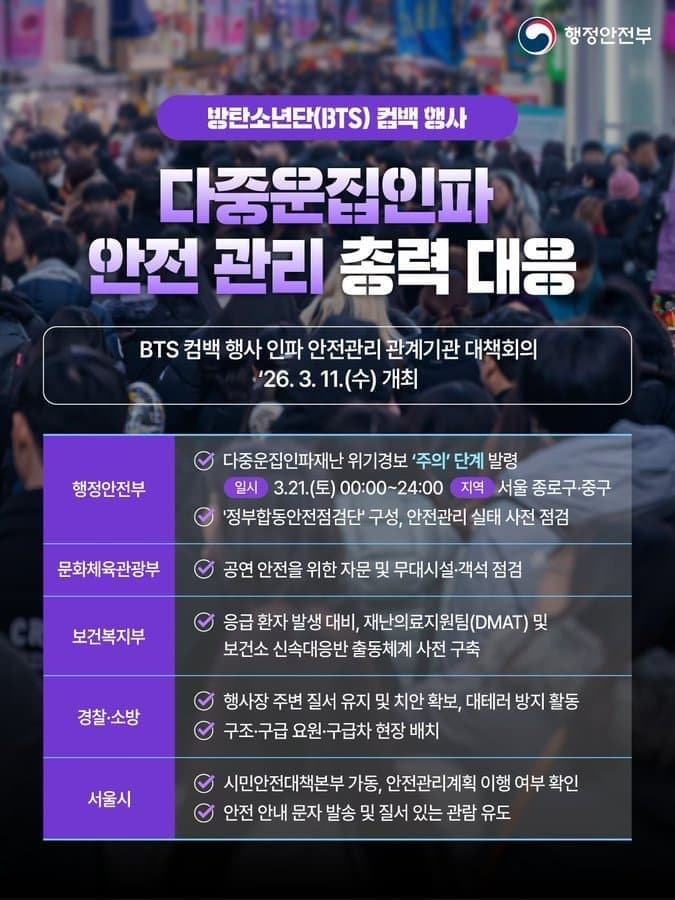
The upcoming BTS comeback showcase at Gwanghwamun Square has triggered a massive mobilization of South Korean administrative resources, marking one of the largest non-state event logistics operations in the country’s history. According to internal planning documents and recent government briefings, the scale of the ‘2026 BTS Gwanghwamun Takeover’ necessitates the direct involvement of the Ministry of the Interior and Safety (MOIS), the Ministry of Culture, Sports and Tourism (MCST), and the Ministry of Health and Welfare (MOHW). This level of coordination is typically reserved for national holidays or international summits, reflecting the anticipated global influx of fans and the inherent safety challenges of hosting a high-profile event in the heart of Seoul.
The Seoul Metropolitan Government confirmed earlier this week that several key administrative sectors are currently finalizing a comprehensive management plan. The objective is to ensure public safety while facilitating a smooth broadcast for millions of global viewers. Unlike standard concert venues, Gwanghwamun Square serves as a central transit hub and a site for major government buildings, making any prolonged closure a significant logistical hurdle for the city. Officials have indicated that the administrative power being deployed is a direct response to the projected crowd density, which experts suggest could exceed the capacity of previous large-scale gatherings at the site.
The Role of National Ministries and Public Safety
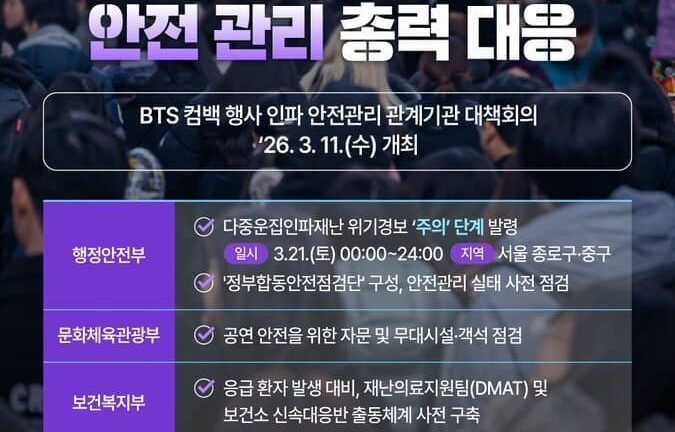
The Ministry of the Interior and Safety has taken a lead role in the ‘Safety Management Committee,’ a task force specifically designed to prevent overcrowding and manage pedestrian flow. This involves a multi-layered security perimeter extending from Gwanghwamun Station to the surrounding arterial roads. The National Police Agency and the Seoul Fire and Disaster Headquarters are expected to deploy thousands of personnel, including specialized crowd control units and emergency medical technicians. For the first time for a K-pop event, the government is reportedly considering the use of real-time AI crowd-density monitoring systems to detect potential bottlenecking in the narrow alleys of Jongno and Sejong-daero.
Health and Welfare officials are focusing on the establishment of temporary medical centers. Given the duration of the event and the likelihood of fans camping or waiting for extended periods, the MOHW is coordinating with local hospitals to ensure a rapid response pipeline for any heat-related illnesses or minor injuries. This medical infrastructure is being built to handle not just the attendees within the square, but the tens of thousands expected to gather in the peripheral areas. The sheer variety of government departments involved has sparked significant discussion among the public regarding the intersection of private entertainment and public service.
“The administrative power being poured into this one comeback is staggering. We are seeing five different ministries and the entire Seoul police force coordinating for a single artist. This is no longer just a ‘music event’; it is effectively a state-sponsored national festival in terms of logistics.”
— Anonymous user on theqoo
Seoul City Infrastructure and Transportation Adjustments
The Seoul Metropolitan Government is bracing for a total transformation of the downtown core. Transportation officials have drafted a plan to increase the frequency of Subway Lines 1, 3, and 5 during the event window. Furthermore, dozens of bus routes will be diverted, and Sejong-daero will likely face partial or total closures. This level of disruption requires the city to manage not only the fans but the millions of commuters who pass through the area daily. The city’s ‘Smart City’ infrastructure will be utilized to provide real-time traffic updates via mobile apps and electronic signage to minimize the impact on the general public.
Waste management and sanitation are also being scaled up to an industrial level. The Seoul City Environment Bureau has reportedly planned for a ‘Zero-Waste’ initiative, deploying hundreds of additional sanitation workers and temporary recycling hubs throughout the Gwanghwamun district. The goal is to return the square to its original state within hours of the event’s conclusion. This rapid-response cleaning protocol is a standard feature of Seoul’s management of large-scale protests and festivals, but the intensity is expected to be heightened given the global media spotlight on the event.
Public Discourse on Administrative Resource Allocation
The announcement of such extensive government support has generated a polarized reaction within domestic online communities. On platforms like theqoo, a post summarizing the involvement of the MOIS, MCST, and other bodies has garnered over 21,000 views and 500 comments within a few hours. While many fans express gratitude for the safety measures, some citizens have raised questions about the use of tax-funded administrative power for a commercial entity’s promotional event. This debate highlights the unique position BTS holds in South Korean society, where their activities are often viewed through the lens of national interest and ‘soft power’ diplomacy.
Supporters of the government’s involvement argue that the economic impact and the boost to Seoul’s international brand justify the expenditure. The Ministry of Culture, Sports and Tourism has emphasized that the event serves as a major draw for international tourists, which in turn benefits local businesses in the Jongno and Jung-gu districts. By ensuring a safe and well-organized event, the government aims to reinforce South Korea’s reputation as a premier destination for global cultural events. The internal consensus among officials appears to be that the cost of potential accidents or logistical failures would far outweigh the cost of proactive administrative mobilization.
“Looking at the list of ministries involved—Interior, Culture, Health, Police, Fire—it’s clear the government is taking zero risks. After the events of the last few years, safety is the only priority. Even if people complain about the ‘administrative power,’ it’s better to be over-prepared than to have a tragedy.”
— User comment from theqoo
Logistical Challenges for HYBE and Global Media
While the government handles the public infrastructure, HYBE is managing the technical complexities of the Gwanghwamun stage. Sources indicate that the stage design must comply with strict weight and height restrictions to avoid damaging the underground utilities and subway tunnels beneath the square. Additionally, the production team is working closely with the Cultural Heritage Administration to ensure that the historic statues of King Sejong and Admiral Yi Sun-sin are protected and integrated respectfully into the broadcast visuals. This collaboration between a private entertainment giant and historical preservationists adds another layer of complexity to the operation.
International media outlets have already begun applying for press credentials in record numbers. The Seoul city government is reportedly setting up a temporary international press center to accommodate hundreds of journalists from around the world. This facility will provide high-speed connectivity and translation services, further blurring the lines between a corporate comeback and a national press event. The global visibility of Gwanghwamun Square during this period is expected to be unprecedented, serving as a massive advertisement for Seoul’s urban landscape.
“The scale of this is essentially a comeback for the entire city of Seoul. The fact that the Ministry of Health and Welfare is involved tells you everything you need to know about the expected crowd size. It’s going to be a historic day for the K-pop industry.”
— Fan reaction on social media
Safety Protocols and Emergency Preparedness
The Seoul Fire and Disaster Headquarters has conducted several tabletop exercises to simulate various emergency scenarios at the square. These drills include medical emergencies, fire hazards, and sudden crowd surges. Emergency exit routes have been mapped out, and a ‘Safety Buffer Zone’ will be maintained between the main stage and the audience areas. The police have also announced a zero-tolerance policy for illegal street vending and unauthorized drone usage, which could interfere with the official broadcast and safety operations. These measures are designed to create a controlled environment within an inherently open public space.
In a statement, a representative from the National Police Agency noted that the deployment is not just about the square itself but about the surrounding subway stations. “We are anticipating significant congestion at Gwanghwamun, City Hall, and Anguk stations. Our officers will be stationed at every major exit to manage the flow of people and prevent platform overcrowding,” the official stated. This holistic approach to safety suggests that the government is treating the comeback as a city-wide security event rather than a localized concert.
Economic Projections and Cultural Legacy
The Ministry of Culture, Sports and Tourism projects that the Gwanghwamun event will generate significant short-term revenue for the hospitality and retail sectors. Hotels in the central Seoul area are already reporting near-total occupancy for the dates surrounding the comeback. The MCST views this as a strategic opportunity to promote the ‘K-Culture’ brand, and they are reportedly planning to air promotional videos for Korean tourism during the event’s global livestream. This synergy between the artist’s IP and national promotion is a hallmark of the current administration’s cultural policy.
As the date approaches, the focus remains on the execution of this massive administrative puzzle. The success of the Gwanghwamun takeover will likely set a new precedent for how large-scale fan events are managed in urban centers. For the government, it is a test of their ability to manage public order in the face of global fandom. For BTS and HYBE, it is a statement of their enduring influence and their ability to command the full attention of the nation’s administrative apparatus. SYNC SEOUL will continue to provide updates as the final schedules and safety guidelines are released by the relevant authorities.
No additional details regarding the specific setlist or guest appearances have been released at this time. Representatives for the Seoul Metropolitan Government declined to comment on the exact budget allocated for the administrative mobilization, citing ongoing negotiations and safety sensitivities. This marks the first time that such a comprehensive array of government bodies has been publicly linked to a single K-pop comeback event.
