




The Persistent Shadow: Why Jisoo Continues to Act
In the vibrant, often cutthroat world of K-dramas, few topics ignite as much fervent debate as the transition of beloved K-pop idols into acting. It’s a path fraught with both immense opportunity and scathing criticism, a tightrope walk where every step is scrutinized under the harsh glare of public expectation. For BLACKPINK’s Jisoo, this journey has been particularly challenging, marked by a persistent ‘bad acting’ label that, five years into her career, she has yet to shake off. This isn’t just a fleeting internet trend; it’s a deep-seated public sentiment, evidenced by the thousands of views and hundreds of comments on recent articles questioning her acting trajectory.
Unpopular opinion, but the conversation surrounding Jisoo’s acting prowess often feels less like constructive criticism and more like a cultural referendum on idol-actors themselves. Yet, the numbers don’t lie: when an article titled, ‘Why does Jisoo act?… Can’t shake the ‘bad acting’ label for 5 years,’ garners over 34,000 views and 800 comments on a popular forum, it’s clear there’s a collective exasperation. As a critic, I’m compelled to ask: in an industry overflowing with talent, why does a mega-idol with such a prominent public image continue down a path that consistently draws such negative feedback? And what does this tell us about the current landscape of K-drama production?
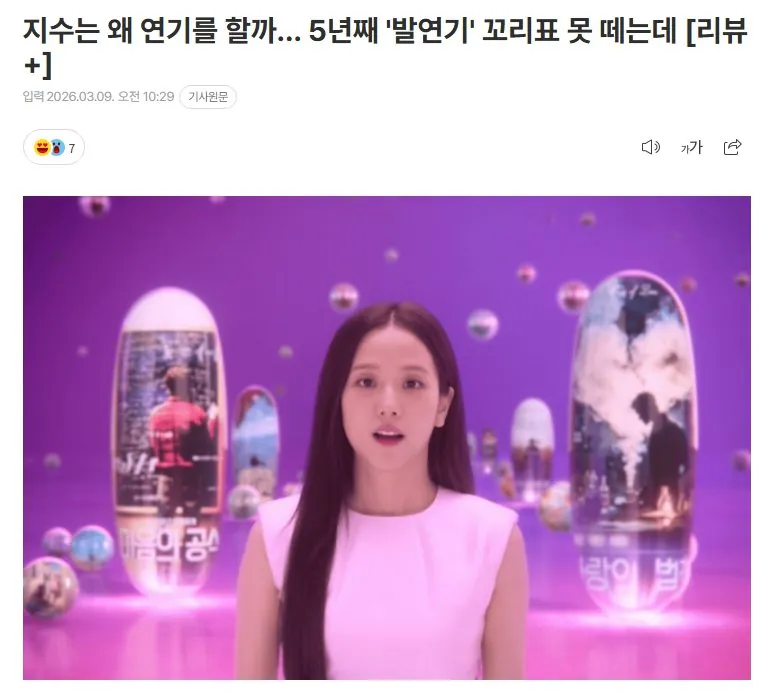
The Idol-Actor Conundrum: A Double-Edged Sword
The journey from idol to actor is, by its very nature, a double-edged sword. On one side, you have an instant, built-in global fanbase, a marketing dream that guarantees viewership and buzz from day one. This is the allure for production companies, the promise of PPL gold and international distribution deals. On the other side, however, lies the crushing weight of expectation and the often-unforgiving scrutiny of a public that demands more than just a pretty face – they demand genuine acting chops.
For Jisoo, her status as a member of BLACKPINK, one of the world’s most influential girl groups, amplifies this effect tenfold. Every twitch, every line delivery, every emotional beat is dissected not just by drama aficionados, but by millions of Blinks and anti-fans alike. Cinematically speaking, this creates a unique challenge for directors. How do you direct an actor whose every move is pre-loaded with years of idol persona? It’s a tightrope walk between leveraging her undeniable star power and trying to mold her into a convincing character. The director’s choice to cast such a high-profile idol can either be a stroke of genius for publicity or a glaring misstep that overshadows the entire production.
Deconstructing ‘Bad Acting’: More Than Just Opinion
So, what exactly constitutes the ‘bad acting’ criticism leveled against Jisoo? It’s rarely a single, isolated flaw but rather a confluence of issues that prevent viewers from suspending disbelief. Often, the critique centers on a perceived lack of emotional depth or a limited range of facial expressions. When a scene calls for profound sadness or simmering anger, and the actor’s face registers only a slight variation of their usual expression, the audience disconnects.
Vocal delivery is another frequent point of contention. In K-dramas, where emotional resonance often hinges on nuanced dialogue and voice modulation, a flat or inconsistent delivery can be fatal. It pulls you out of the story, reminding you that you’re watching an idol, not a character. The mise-en-scène here, no matter how beautifully composed or expertly lit, cannot compensate for a performance that feels, at its core, unconvincing. This isn’t about being ‘ugly crying’; it’s about conveying a genuine internal state that resonates with the audience, a masterclass in subtlety that many idol-actors struggle to achieve without extensive training and experience.
“Honestly, every time Jisoo appears, I can’t help but see ‘Jisoo from BLACKPINK.’ The character just disappears. It’s so distracting.” – Netizen from TheQoo
The Business Imperative: Why Productions Still Choose Idols
Given the consistent backlash, one might wonder why production companies continue to cast idols like Jisoo in prominent roles. The answer, regrettably, often lies less in artistic merit and more in cold, hard economics. An idol of Jisoo’s caliber brings an unprecedented level of global visibility. Her name alone can secure pre-sales, attract international streaming platform deals, and guarantee massive social media engagement long before the first episode airs.
Furthermore, PPL (Product Placement) opportunities become significantly more lucrative. Brands clamor to have their products associated with a BLACKPINK member, translating into substantial revenue for the drama. In this commercial ecosystem, the ‘acting’ itself can, at times, become secondary to the ‘star power.’ It’s a harsh reality, but for many producers, the guaranteed global reach and financial benefits outweigh the potential critical drubbing. This isn’t to say all idol-casting is purely mercenary, but the immense brand value Jisoo carries is an undeniable factor that often trumps raw talent in the initial casting stages.

The Road Less Traveled: Training and Growth
For idol-actors to truly transition successfully, a significant commitment to intensive acting training is paramount. It’s not enough to rely on natural charisma or a charming smile. The craft of acting requires years of dedication, studying techniques, understanding character development, and honing emotional expression. We’ve seen numerous examples of idols who have made this transition seamlessly, often starting with smaller, supporting roles that allow them to grow organically without the pressure of carrying an entire series.
Contrast this with the trajectory of some, like Jisoo, who are often thrust into lead roles almost immediately. While the intention might be to capitalize on their popularity, it can inadvertently expose their inexperience. The writing here often struggles to build a character arc that feels authentic when the actor themselves is still finding their footing. The industry needs to foster environments where idols can genuinely develop their acting skills, perhaps through theater work or independent films, before being placed in high-stakes, prime-time productions.
“I wish her agency would give her proper acting lessons instead of just throwing her into projects. It’s not fair to her or the audience.” – Another Netizen Comment
Unpopular Opinion: The Audience’s Role in Perpetuating the Cycle
Here’s an unpopular opinion, but the audience also plays a role in this cycle. While the criticism is valid, the sheer volume of engagement on articles like the one discussing Jisoo’s acting, or even the initial viewership numbers of her dramas, sends a mixed signal to the industry. If a drama starring a popular idol still generates immense buzz and decent ratings (even if critically panned), it reinforces the notion that star power alone is enough. This isn’t an excuse for subpar performances, but rather an observation on market dynamics.
What elevates this discussion beyond simple fan wars is the question of integrity in storytelling. When casting decisions are predominantly driven by commercial viability rather than artistic suitability, the overall quality of K-dramas, a genre celebrated globally for its compelling narratives and stellar performances, risks being diluted. The writing falters when it has to contort itself to fit a star’s limitations, and the direction becomes a series of aesthetic compromises rather than bold artistic statements.
“At this point, it feels like they’re just using her for the BLACKPINK name. Is she truly passionate about acting, or is it just another brand deal?” – Anonymous Online User
The Final Verdict: A Crossroads for Jisoo and the Industry
After five years, the ‘bad acting’ label clinging to Jisoo is more than just a passing critique; it’s a significant barrier to her artistic growth and public acceptance as an actress. While her dedication cannot be entirely dismissed, the consistent feedback indicates a fundamental disconnect between her performances and the demands of dramatic storytelling. She delivers charisma as an idol, but the nuanced emotional range required for complex characters remains elusive.
The industry, too, is at a crossroads. The allure of idol star power is undeniable, but at what cost to artistic integrity? If K-dramas are to maintain their global reputation for excellence, a recalibration is needed. This means prioritizing genuine talent and rigorous training over sheer popularity, allowing idol-actors to develop their craft authentically. For Jisoo, the path forward is clear: either commit to intensive, foundational acting training away from the limelight, or perhaps reconsider if acting is truly the artistic avenue where she can genuinely excel and contribute. Otherwise, the ‘bad acting’ label will continue to overshadow any potential she might have, leaving both critics and audiences perpetually questioning ‘why’.
“She just doesn’t have ‘it’ for acting. It’s okay to be amazing at one thing (singing/dancing) and not another. Not everyone needs to do everything.” – Popular Forum Comment
Technical Breakdown
While a full drama review isn’t the focus here, an assessment of the elements often criticized in her performances yields:
- Writing: ⭐⭐⭐☆☆ (Often constrained by limited actor range)
- Direction: ⭐⭐⭐☆☆ (Can struggle to elevate performances)
- Acting: ⭐⭐☆☆☆ (Inconsistent emotional depth, limited range)
- Production: ⭐⭐⭐⭐☆ (High budget, but acting can detract)
- OST: ⭐⭐⭐☆☆ (Often strong, but can’t save a weak performance)
Overall: 4/10 (Based on acting contribution to overall drama quality)
Watch if: You’re a die-hard fan and can overlook acting critiques for the sake of seeing your idol on screen.
Skip if: You prioritize strong performances and immersive storytelling above all else.