



MCST Unveils 2026 Global Hallyu Survey Results
The Ministry of Culture, Sports and Tourism (MCST), in conjunction with the Korean Foundation for International Cultural Exchange (KOFICE), has officially released the results of the ‘2026 Overseas Hallyu Research’ report. This annual publication, widely regarded as the most comprehensive data set regarding South Korea’s cultural export performance, provides a detailed look at which figures and artists hold the most significant sway over international audiences. As of March 31, 2026, the data confirms a familiar yet evolving landscape where established icons continue to defend their territory against a rapidly diversifying field of competitors. The survey, which utilized open-ended questions to ensure unbiased responses from thousands of participants across major global markets, highlights the enduring legacy of the ‘Third Generation’ of K-Pop while acknowledging the rise of individual soloists and non-musical figures.
According to the official statement released by the Ministry, the 2026 rankings are divided into two primary categories: ‘Most Influential Hallyu Figures’ and ‘Favorite Korean Singers.’ The results indicate that the definition of Hallyu influence is expanding beyond traditional entertainment silos. While K-Pop remains the primary driver of interest, the inclusion of e-sports professionals and veteran actors in high positions suggests that the ‘K-Brand’ is becoming more holistic. Government officials noted that the consistency of these rankings provides a stable foundation for cultural diplomacy and targeted marketing strategies in regions like North America, Europe, and Southeast Asia. This data serves as a critical benchmark for agencies and brands looking to capitalize on the global reach of Korean talent in the coming fiscal year.
BTS Maintains Dominance Amidst Solo Chapter Transitions
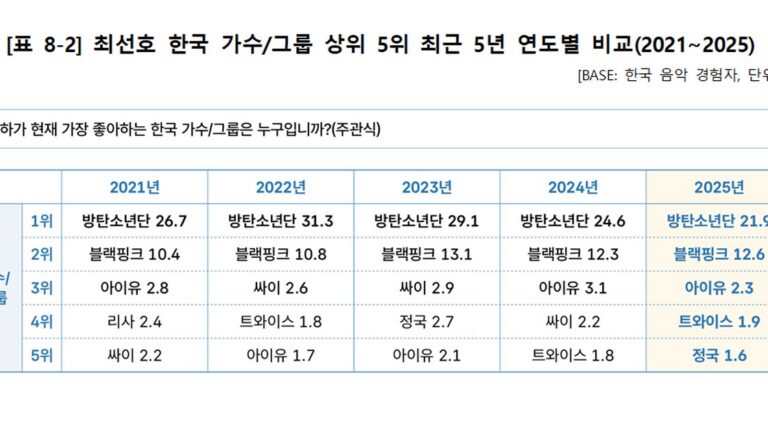
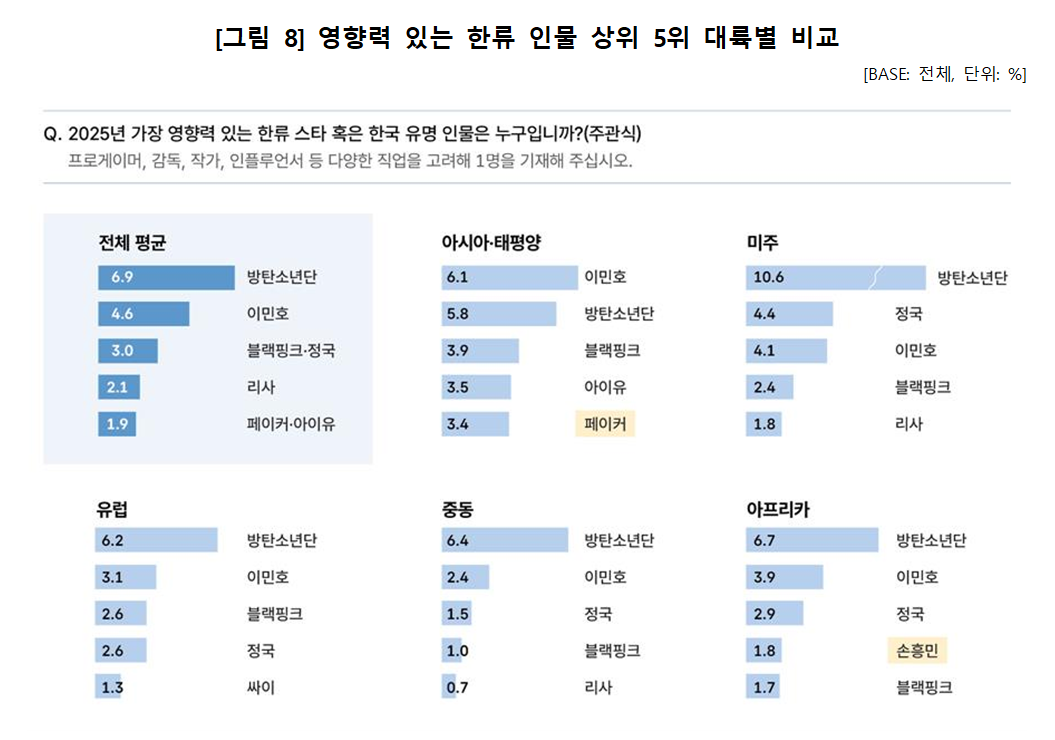
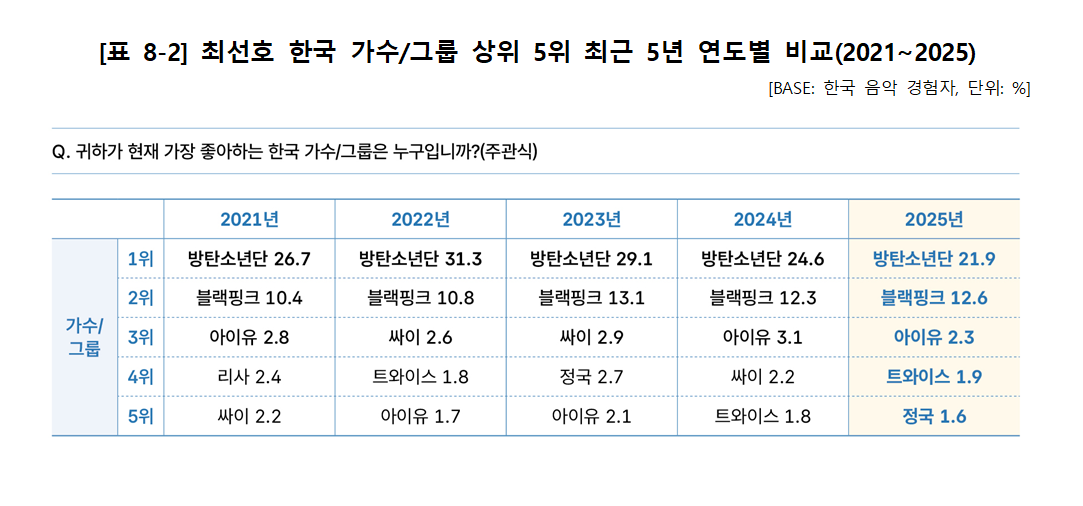
For the tenth consecutive year, BTS has secured the top position as the ‘Most Influential Hallyu Figure’ and the ‘Favorite Korean Singer’ globally. This achievement is particularly significant given the group’s recent history of staggered military enlistments and the subsequent focus on solo activities. The data suggests that the BTS brand operates independently of the group’s collective activity status, maintaining a level of ‘top-of-mind’ awareness that remains unparalleled in the industry. Analysts point to the successful rollout of individual projects throughout recent years as the primary reason for this sustained dominance. By maintaining a constant presence in the charts through diverse solo releases, the members have ensured that the group name remains at the forefront of the global cultural conversation.
The impact of the group is further evidenced by the individual ranking of Jungkook, who secured the third spot in the ‘Influential Hallyu Figure’ category (tied with BLACKPINK) and the fifth spot in the ‘Favorite Korean Singer’ list. This dual presence—both as a group and as an individual—highlights a strategic shift in how HYBE manages its premiere intellectual property. Jungkook’s success in the 2026 rankings reflects his status as a global pop icon who has successfully transcended the traditional ‘K-Pop idol’ label. His performance in Western markets, specifically the United States and the United Kingdom, has contributed significantly to his high standing in this year’s government report.
“BTS being #1 for nearly a decade is actually insane when you think about the turnover in this industry. Even with the members doing their own thing lately, the brand is just untouchable. It’s not just music anymore; it’s a cultural phenomenon that the government literally tracks as a national asset.”
— Verified user on a major K-Pop community forum
The Rise of the Individual: BLACKPINK and Lisa as Standalone Powerhouses
BLACKPINK remains the most influential female force in the Hallyu wave, ranking second in the ‘Favorite Korean Singer’ category and third in ‘Influential Hallyu Figures.’ Much like their counterparts in BTS, the members of BLACKPINK have demonstrated an extraordinary ability to maintain group relevance while building massive individual brands. The 2026 data shows that the group’s hiatus from collective musical releases has not diminished their standing; rather, their presence in high-fashion, cinema, and solo music ventures has reinforced their status as global trendsetters. The agency’s strategy of ‘quality over quantity’ appears to be paying dividends in terms of long-term brand equity.
Lisa, in particular, has carved out a unique space in the 2026 rankings, placing fourth on the ‘Influential Hallyu Figure’ list. Her ranking is a testament to her immense popularity in Southeast Asia and her growing influence in the European market. As a solo artist, Lisa has managed to capture a demographic that extends beyond the traditional K-Pop fandom, positioning herself as a multi-hyphenate entertainer. The Ministry’s report specifically mentions that Lisa’s influence is a key factor in the sustained growth of Hallyu in regions where local cultural barriers were previously difficult to penetrate. Her success provides a blueprint for how non-Korean members of K-Pop groups can leverage their heritage and global appeal to become pillars of the Hallyu movement.
Beyond Music: Lee Min-ho and Faker Redefine Hallyu Influence
One of the most striking aspects of the 2026 ‘Influential Hallyu Figure’ list is the second-place ranking of actor Lee Min-ho. Despite the rapid influx of new talent in the K-Drama industry, Lee Min-ho has maintained a top-three position for several years. His enduring popularity underscores the different lifecycle of actors compared to idols. While music trends shift monthly, the loyalty of drama viewers tends to be more resilient. The Ministry’s analysis suggests that Lee Min-ho’s role in major streaming platform originals over the past two years has solidified his status as the global face of Korean television. His appeal spans generations, making him a preferred choice for luxury brands and international advertisements.
Perhaps the most discussed entry in this year’s top five is the inclusion of ‘Faker’ (Lee Sang-hyeok) in the ‘Influential Hallyu Figure’ category, where he shares the fifth spot with IU. This marks a pivotal moment in the history of the MCST rankings, as it is the first time an e-sports professional has cracked the top five of a general Hallyu influence survey. Faker’s presence alongside pop icons and movie stars reflects the changing consumption habits of global audiences, particularly Gen Z and Gen Alpha. As competitive gaming becomes a central pillar of digital culture, the figures associated with it are being recognized as legitimate cultural ambassadors for South Korea.
“Faker being in the top 5 for ‘Hallyu Figure’ next to IU and BTS shows that e-sports is finally getting the mainstream recognition it deserves. It’s not just about ‘gamers’ anymore; he’s a national representative. This is a huge win for the T1 fans and the entire gaming community.”
— Social media comment with 1,200+ likes
IU and TWICE: The Resilience of Established Icons
IU continues to prove her status as the ‘Nation’s Sweetheart’ with a global reach, ranking third in the ‘Favorite Korean Singer’ category and fifth in ‘Influential Hallyu Figures.’ Her ability to maintain high rankings in both categories is a rarity, as she manages to balance critical acclaim in Korea with a growing international fanbase. Unlike many artists who focus solely on high-energy performances, IU’s influence is driven by her songwriting and her crossover success as an actress. The 2026 report indicates that her recent world tour and high-profile collaborations have significantly boosted her recognition in markets that were previously dominated by idol groups.
TWICE also maintains a strong position, ranking fourth in the ‘Favorite Korean Singer’ category. Their inclusion is a clear indicator of the ‘TWICE-style’ longevity. By consistently releasing music and touring extensively in Japan and North America, the group has built a dedicated and stable fandom that resists the ‘new group’ fatigue often seen in the industry. The Ministry noted that TWICE remains a primary example of successful localization strategies, particularly in the Japanese market, where they continue to set records for attendance and sales. Their presence in the top five, even as ‘Fifth Generation’ groups begin to emerge, speaks to the deep emotional connection they have established with their audience.
“Lee Min-ho is the undisputed king of K-Dramas. New actors come and go, but his global fanbase is just built different. He doesn’t even need to have a drama airing every month to stay at the top of these lists. That’s real star power.”
— Fan reaction from a popular international drama blog
Strategic Analysis: The Future of Korean Cultural Exports
The 2026 Hallyu Power List reveals a market that is both consolidating and diversifying. On one hand, the ‘Big Three’—BTS, BLACKPINK, and IU—continue to hold the majority of the cultural capital. On the other hand, the emergence of figures like Faker and the solo success of members like Lisa and Jungkook suggest that the future of Hallyu lies in individual branding and cross-platform influence. For agencies like HYBE, YG, and JYP, the challenge moving forward will be to replicate the longevity of these icons with their newer rosters. The data suggests that global audiences are increasingly looking for ‘authentic’ figures who represent more than just a musical genre.
Furthermore, the Ministry of Culture, Sports and Tourism has indicated that these results will inform the government’s future cultural budget allocations. There is an expected increase in support for e-sports infrastructure and solo artist global promotions, reflecting the shifts seen in this year’s survey. As the digital landscape continues to evolve, the boundaries between different forms of media—music, gaming, and television—are blurring. The 2026 rankings are not just a list of names; they are a roadmap for the next phase of Korean soft power on the global stage. Industry stakeholders are advised to look closely at the demographic breakdowns of these results to identify emerging markets where Hallyu has yet to reach its full potential.
In summary, the 2026 rankings confirm that while the faces of Hallyu remain largely consistent at the very top, the nature of their influence is expanding. The dominance of BTS and BLACKPINK provides a stable anchor for the industry, while the inclusion of diverse figures like Faker and Lee Min-ho ensures that the Korean wave remains a multi-faceted global phenomenon. As we move further into 2026, the focus will likely shift toward how these top-ranked figures use their influence to usher in the next generation of Korean talent. For now, the ‘unshakable throne’ of the established icons remains secure, backed by both public sentiment and official government data.