




The Current State of the 30 Billion Won Lawsuit
On March 26, 2026, the Seoul Central District Court held a pivotal hearing in the ongoing civil litigation between ADOR and NewJeans member Danielle. The atmosphere in the courtroom was reportedly tense as legal representatives for both sides presented their preliminary arguments regarding a massive 30 billion KRW (approximately $22.4 million USD) claim for damages. This lawsuit, which has dominated industry headlines since its filing earlier this year, centers on allegations of contract violations and the attempted termination of exclusive artist agreements. However, the day’s proceedings took a sharp turn when the conversation shifted toward the foundational requirements of the case: the evidence.
Legal counsel for ADOR, acting as the plaintiff, faced immediate scrutiny from the presiding judge regarding the status of their evidentiary submissions. In a moment that has since gone viral across Korean social media platforms, the court inquired whether both parties were prepared to present digital evidence to support their respective claims. The response from ADOR’s legal team was unexpectedly candid, admitting that they had not yet secured sufficient materials. “In truth, we have not been able to collect much evidence at this stage,” the plaintiff’s representative stated. This admission has raised significant questions among legal analysts regarding the strategic intent behind filing such a high-value lawsuit without a robust evidentiary trail already in place.

A Lack of Digital Evidence from the Prosecution
Courtroom observers noted that the judge appeared dissatisfied with the plaintiff’s request for additional time to gather materials. The legal standard for filing a claim of this magnitude typically requires a clear demonstration of breach of contract or financial loss prior to the commencement of the trial. By admitting that evidence collection is still in its infancy, ADOR has inadvertently fueled public speculation that the lawsuit may be more about procedural delay or reputational pressure than a pursuit of compensable damages. Industry insiders have pointed out that digital forensics, which usually form the backbone of modern contract disputes, should have been the first step in the agency’s legal strategy.
Several legal experts specializing in entertainment law suggest that the lack of evidence might indicate a broader struggle within ADOR’s current management to substantiate their claims of “artist tampering” or “unauthorized contact” with third parties. Without logs, messages, or documented financial transfers, the 30 billion KRW figure remains a theoretical calculation rather than a proven loss. The court emphasized that the burden of proof lies squarely with the plaintiff, and any further requests for delays to “find” evidence would be met with skepticism. This firm stance by the judiciary suggests a desire to prevent the legal system from being used as a tool for corporate maneuvering.
“The realization that they have zero evidence but are still pushing for a 30 billion won lawsuit is staggering. It feels like this was never about the law, but about keeping a member tied up in court for as long as possible,” commented one observer on the community platform Instiz.
The 45 Billion Won Calculation and Financial Stakes
Beyond the immediate 30 billion KRW claim against Danielle, the hearing touched upon broader financial dynamics within the HYBE-ADOR ecosystem. Reports surfaced during the proceedings suggesting that the total financial exposure involved in the NewJeans legal battles could exceed 45 billion KRW. This figure reportedly represents the projected “value” HYBE and ADOR believe they can extract through litigation and contract maintenance, compared to the potential losses of a clean break. The disparity between these numbers and the lack of physical evidence has led to accusations of “creative accounting” in the agency’s legal filings.
Financial analysts monitoring the K-pop sector have expressed concern over how these legal costs and potential settlements will impact the agency’s bottom line in the 2026 fiscal year. While ADOR remains a subsidiary of HYBE, the mounting legal fees and the risk of losing a high-profile case could have ripple effects on the parent company’s stock price. The aggressive pursuit of Danielle, specifically, is seen by many as a calculated move to set a precedent for the other members of NewJeans. By targeting a single member with an astronomical sum, the agency may be attempting to deter collective action from the group, though the current lack of evidence appears to be undermining that strategy.

Min Hee-jin’s Intervention and Proposed Settlement
The narrative surrounding this case is further complicated by the recent actions of former ADOR CEO Min Hee-jin. Information disclosed during the hearing period suggests that Min offered a significant compromise to resolve the conflict. According to sources familiar with the discussions, Min proposed waiving her own 25 billion KRW claim against the company on the condition that ADOR drop its lawsuits against the NewJeans members and allow the group to maintain its current five-member lineup under agreed-upon terms. This move was framed as an attempt to prioritize the artists’ careers over financial retribution.
However, HYBE and the current ADOR management reportedly rejected this overture. The decision to decline a 25 billion KRW waiver in favor of pursuing a 45 billion KRW recovery through litigation suggests a hardline approach. This rejection has been interpreted by the public as a sign that the agency is more interested in the total dissolution of the “Min Hee-jin era” than in finding a mutually beneficial resolution. The refusal to settle, combined with the admission that they lack evidence, has created a PR challenge for the agency, as fans and the general public increasingly view the litigation as a form of institutional bullying.
“Min Hee-jin was willing to give up 25 billion won just to protect the girls, but the company said no because they think they can squeeze 45 billion out of Danielle. It’s pure greed over human talent,” a fan wrote on Twitter (X) following the hearing summary.
Procedural Delays and the Court’s Response
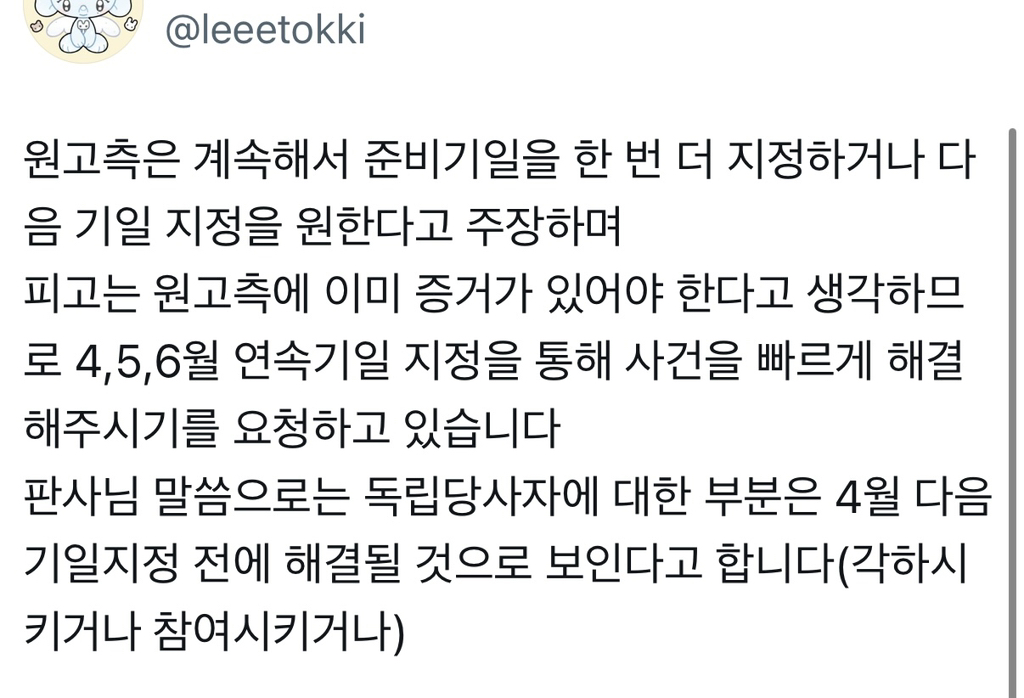
A significant portion of the March 26 hearing was dedicated to ADOR’s request for a postponement of the next trial date. The plaintiff argued that they needed more time to “organize and synthesize” the evidence they intend to present. This request was met with a blunt refusal from the presiding judge, who noted that the lawsuit had already been active for several months. The court’s refusal to grant a delay is a critical development, as it forces ADOR to proceed with whatever materials they currently possess, or risk having the case dismissed for lack of merit.
This “no-delay” policy from the judge indicates a growing impatience with the pace of celebrity litigation in Korea. Often, large agencies use the discovery phase to prolong cases, effectively freezing an artist’s career during their most productive years. By denying the delay, the court is signaling that it will not allow the legal process to be used as a de facto injunction against the artist’s activities. For Danielle and her legal team, this is seen as a major procedural victory, as it brings the case closer to a definitive ruling rather than an endless cycle of hearings.
Public Reaction and Industry Implications
The reaction from the K-pop community has been overwhelmingly critical of ADOR’s recent courtroom performance. On platforms like Instiz, TheQoo, and X, the hashtag #ProtectNewJeans has trended alongside discussions about the “absurdity” of a 30 billion won lawsuit without digital proof. Many fans have expressed shock at the agency’s admission, with some suggesting that the lawsuit was filed primarily to generate negative headlines about Danielle rather than to win a legal judgment. This sentiment is particularly strong given the group’s massive international following and their status as a cultural phenomenon.
Industry observers are also watching the case closely for its potential impact on future artist-agency relations. If ADOR fails to produce evidence and the case is dismissed, it could empower more artists to challenge restrictive contracts or aggressive litigation tactics. Conversely, a prolonged battle—even one without merit—serves as a cautionary tale about the financial and emotional toll of standing up to a major entertainment conglomerate. The case has become a litmus test for the fairness of the South Korean entertainment legal system in the face of massive corporate power.
“They are literally trying to create evidence out of thin air now. The judge saw right through it. This is why we need better laws to protect idols from these predatory lawsuits,” read a highly-upvoted comment on a news portal.
The Road Ahead for NewJeans and ADOR
As the case moves toward its next phase, the focus will remain on whether ADOR can produce any tangible evidence to support its claims of contract interference. The next hearing is expected to take place in the following month, and the court has made it clear that no further extensions will be granted for the submission of primary evidence. This puts the agency in a difficult position: they must either find the “smoking gun” they currently lack or face a significant legal defeat that could lead to the termination of Danielle’s contract with no compensation for the agency.
For Danielle, the legal battle remains a significant hurdle, but the recent hearing has provided a glimpse of hope. The court’s refusal to allow further delays means that a resolution—one way or the other—is approaching faster than many anticipated. While the financial stakes remain high, the lack of evidence presented by ADOR suggests that the agency’s position is far more precarious than their public statements would suggest. As the industry awaits the next development, the question remains: was this a legitimate legal grievance, or a multi-billion won gamble that is beginning to fail?
The broader implications for NewJeans as a group are also at stake. With the members continuing to show solidarity, the outcome of Danielle’s case will likely dictate the strategy for the remaining four members. If the court continues to hold ADOR to a high standard of proof, it may pave the way for a collective resolution that allows the group to move forward with their careers, free from the shadow of the current litigation. For now, the eyes of the K-pop world remain fixed on the Seoul Central District Court.