

The Weight of a Classic: Why ‘The Flower that Bloomed in the Palace’ Matters
Cinematically speaking, the K-drama landscape has been saturated with ‘healing’ narratives and soft-focus rom-coms. While there is a place for comfort, the collective thirst for a high-stakes, emotionally devastating period piece has never been more apparent. Enter the swirling rumors surrounding the adaptation of The Flower that Bloomed in the Palace (궁에는 개꽃이 산다). For the uninitiated, this isn’t just another palace romance; it is a masterclass in psychological warfare and toxic devotion. The original novel by Yoon Tae-roo is legendary for its portrayal of Gaeri, perhaps the most ‘villainous’ female protagonist in the genre, and Un, the Emperor whose coldness is as sharp as a blade.
Discussion boards like ‘theqoo’ have been set ablaze recently with a post that garnered over 8,000 views in a matter of hours. The central question? Who has the gravitas to stand opposite the rumored female lead, Park Eun-bin, and embody the cruel, complex, and ultimately tragic Emperor Un? This isn’t a role for a novice. It requires an actor who can deliver lines that are essentially verbal daggers while maintaining a shred of humanity that keeps the audience from turning off their screens. The source material demands a performance that balances on a razor’s edge between hatred and an obsessive, buried love.
“If this adaptation doesn’t capture the sheer vitriol in Un’s voice when he tells Gaeri he’d never have a child with her, what’s the point? We need someone who can look genuinely disgusted yet captivated.” — User ‘SageukStan99’ on theqoo
Park Eun-bin as Gaeri: A Casting Masterstroke?
Before we dive into the male leads, we have to address the elephant in the room: the potential casting of Park Eun-bin as Gaeri. After her recent transformative roles, Park has proven she can handle anything from neurodivergence to historical gender-bending. However, Gaeri is a different beast entirely. She is selfish, manipulative, and fiercely protective of her position. If Park Eun-bin takes this on, we are looking at a career-defining subversion of her ‘nation’s sweetheart’ image. The chemistry between her and the chosen ‘Un’ will dictate whether this drama becomes a masterpiece or a forgettable melodrama.
The writing falters when the male lead is merely a ‘tsundere’ archetype. Un is not a tsundere; he is a man who genuinely finds Gaeri’s temperament repulsive. The dialogue provided in the recent fan-cast threads highlights a scene where Un tells Gaeri, \”If a child were born from your body, they would be just like you. Could you even raise such a child?\” This is visceral, nasty writing that requires an actor with a low register and an even colder gaze. Starting the narrative with such a deep-seated ‘악연’ (vicious cycle/ill-fated relationship) is what sets this story apart from the fluff we’ve seen on streaming platforms lately.
The Sageuk Specialists: Lee Joon-gi and Yoo Seung-ho
When the term ‘Palace’ is in the title, Lee Joon-gi’s name is inevitably the first to be whispered. His performance in Moon Lovers: Scarlet Heart Ryeo remains the gold standard for ‘damaged royalty.’ Lee has a unique ability to use his eyes to convey a thousand years of resentment. However, some critics argue that casting Lee might feel like a retread of familiar ground. At this stage in his career, would he want to return to the throne? If he did, his Un would likely be more tragic than cruel, emphasizing the loneliness of the crown over the toxicity of the relationship.
On the other hand, Yoo Seung-ho offers a different kind of intensity. Often called ‘Little So Ji-sub,’ Yoo has grown into an actor who excels at portraying suppressed rage. His voice has a rhythmic quality that would suit the archaic, formal speech of the Goryeo or Joseon-inspired setting. Fans have pointed out that his chemistry with Park Eun-bin in previous projects (going all the way back to their child actor days) would add a meta-layer of emotional resonance for long-time K-drama viewers. It would be a full-circle moment for the industry.
“Lee Joon-gi is the King, but Yoo Seung-ho has that specific ‘sad-angry’ look that Un needs when he realizes he can’t actually get rid of Gaeri.” — Comment #42 on theqoo post
The Modern Dark Horses: Lee Joon-hyuk and Lee Hyun-wook
Unpopular opinion, but the best fit for Un might not be a traditional sageuk star. Lee Joon-hyuk, fresh off his villainous streak in recent cinema, has the exact ‘cold-blooded’ aesthetic required for the role. There is a stillness to his acting that can be incredibly unnerving. Imagine him delivering a monologue about the ‘transactional nature’ of the Empress’s seat while staring blankly into the distance. It would be chilling. He doesn’t rely on grand gestures; he relies on the slight twitch of a jaw muscle, which is perfect for a character who prides himself on his lack of emotion.
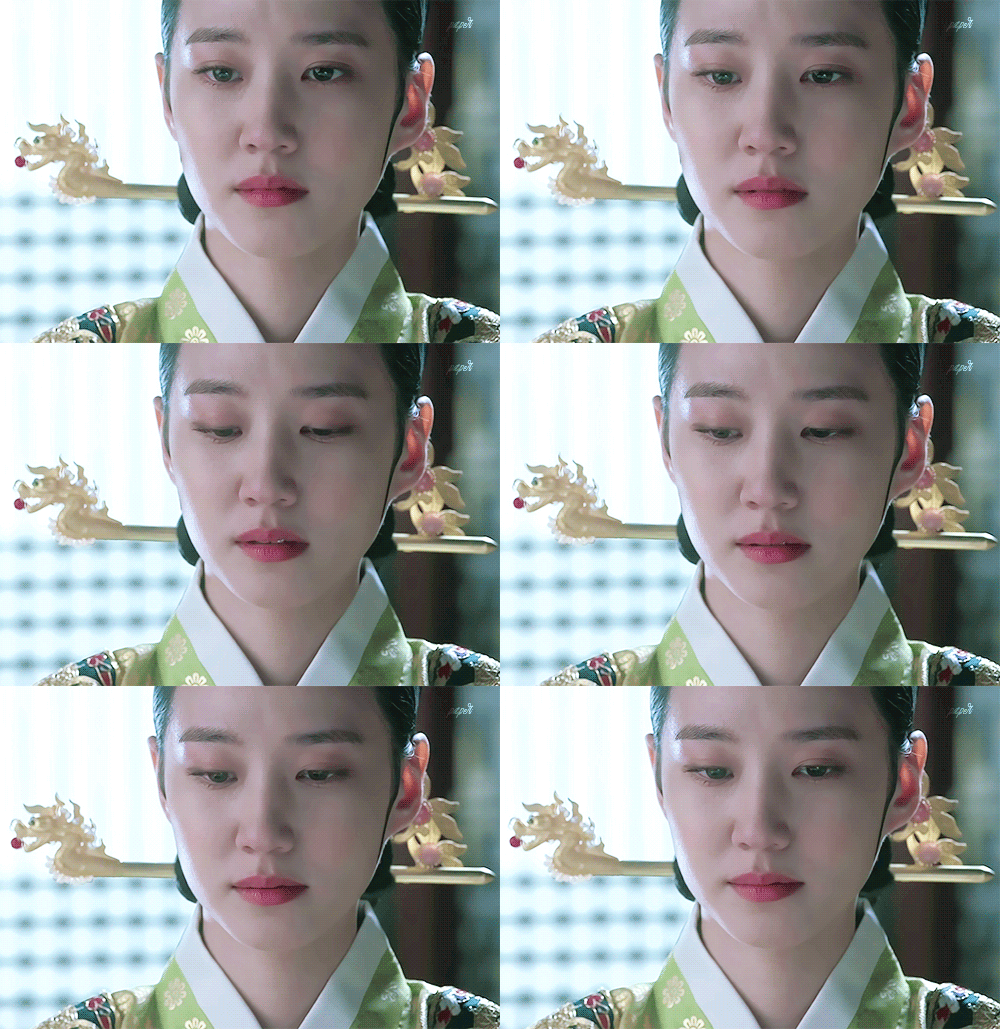
Similarly, Lee Hyun-wook is a name that keeps popping up in ‘villain’ casting circles. He has a ‘sharp’ face—high cheekbones and piercing eyes—that fits the description of a man who was born into power and has no patience for those he deems beneath him. His portrayal of Un would likely lean into the ‘psycho-palace’ vibes, making the eventual romantic shift (if the drama follows the novel’s redemptive arc) all the more shocking. This kind of ‘edgy’ casting is exactly what SYNC SEOUL appreciates—moving away from the ‘safe’ choices to find the artistic truth of a character.
The Visual Icons: Park Bo-gum and Seo Kang-joon
Then there are the ‘Face Geniuses.’ Park Bo-gum as Un would be the ultimate subversion. We are so used to seeing him as the bright, optimistic youth. Seeing him sneer at Gaeri and tell her she lacks the qualities of an Empress would be a ‘visual shock’ (비주얼 쇼크) that could drive ratings to record highs. It’s the kind of ‘dark transformation’ that actors of his caliber crave to prove their range. The contrast between his soft features and the harshness of the script would create a fascinating cognitive dissonance for the audience.
Seo Kang-joon, who returned to the industry with a renewed sense of depth, is another strong contender. His light-colored eyes have always given him an otherworldly, somewhat detached appearance. For a character like Un, who feels alienated from his own court, this physical trait is a massive asset. Seo’s acting style has become more minimalist over the years, which would serve the early episodes of the drama well, where Un is more of an observer of Gaeri’s chaos than a participant in it.
“I just want to see Park Bo-gum be mean for once. The dialogue in the novel is so brutal, imagine that coming out of his mouth? It would be legendary.” — User ‘DramaLover’
Technical Demands: Mise-en-scène for a Poisonous Palace
As a critic, I look beyond the faces. The director’s choice for The Flower that Bloomed in the Palace will be crucial. This isn’t a story that can be told in bright, saturated colors. We need the shadows of My Dearest combined with the claustrophobic framing of The Red Sleeve. The mise-en-scène must reflect the internal state of the characters—lavish on the outside, but cold and decaying on the inside. The cinematography should utilize long takes during the heavy dialogue scenes to allow the actors to truly inhabit the tension.
Furthermore, the OST will need to avoid the typical soaring ballads. We need something more dissonant—traditional Korean instruments played with a modern, darker twist. Think of the tension-building scores in recent thrillers. If the music is too romantic, it will betray the complexity of the source material. The production value needs to justify the hype, especially if they are courting A-list stars like the ones mentioned in the theqoo thread. Fans are already scrutinizing every detail, from the historical accuracy of the costumes to the specific wording of the script leaks.
Leah’s Final Verdict: The Top Three Contenders
After analyzing the source text and the current trajectory of the candidates, I have narrowed down the list. While all the actors mentioned—including the likes of Ji Chang-wook, Kang Ha-neul, and Kang Tae-oh—bring something unique to the table, three stand out as the most ‘cinematically’ interesting choices.
First, Lee Joon-hyuk. He is the most ‘accurate’ to the Un of the novel—a man whose coldness is not a facade but a fundamental part of his being. Second, Yoo Seung-ho. His history with the genre and his chemistry with the rumored female lead make him the most ‘reliable’ choice for a high-budget production. Finally, Park Bo-gum. This is the ‘wild card’ choice. It is the casting that would generate the most buzz and potentially offer the most rewarding performance if he can successfully shed his ‘good boy’ image.
Regardless of who is eventually cast, The Flower that Bloomed in the Palace is poised to be the most talked-about drama of the year. It challenges our perceptions of ‘protagonists’ and ‘romance’ in a way that few K-dramas dare to do. As a critic, I’m tired of the ‘safe’ choices. I want a drama that makes me uncomfortable. I want a drama that makes me debate the ethics of its characters in the comments section. With the right ‘Un,’ this could be the masterpiece we’ve been waiting for since the recent sageuk revival. Watch this space—I’ll be the first to break down the first teaser when it inevitably drops.