


The 1,460-Day Wait: Quantifying the Return of BTS
Statistically speaking, the return of BTS to the global music stage in March 2026 was always going to be the most significant data event of the decade. After a four-year hiatus that saw the individual members diversify their portfolios through solo ventures and mandatory service, the anticipation for ARIRANG reached a fever pitch. On domestic platforms like TheQoo, a single thread discussing the official critical reception garnered over 27,131 views and 204 comments within hours of posting. This level of engagement metrics suggests that while the group’s physical presence was absent, their market share in the cultural conversation remained virtually untouched. However, the numbers tell a more complex story when we move from engagement to critical consensus. The long-awaited project has debuted to a polarizing reception that challenges the group’s historical dominance in the ‘prestige’ critical sphere.
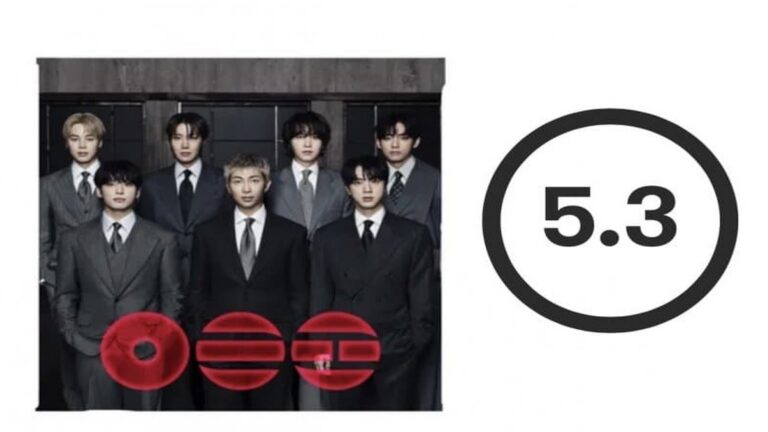
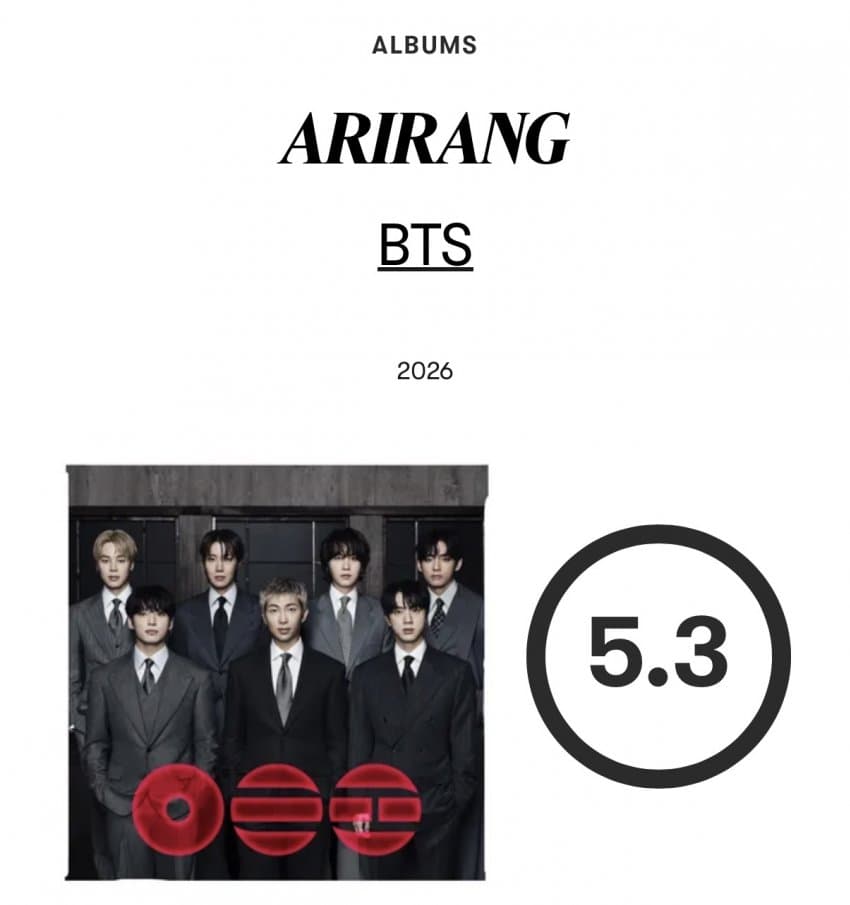
The data suggests a disconnect between the commercial machinery of the comeback and the artistic execution. Pitchfork’s official review—which many fans initially dismissed as a rumor before its verified release—points to a score that reflects a significant downward trend compared to their previous peaks. The critique centers on a perceived lack of ‘spirit and vigor,’ suggesting that the very elements that propelled BTS to global hegemony might now be the factors hindering their creative evolution. For a group that has built its brand on authenticity, being described as sounding ’empty’ is a metric that their management team at HYBE will likely find difficult to pivot around in the coming quarterly reports.
What is particularly interesting is the specific vocabulary used by international critics to describe the album’s sonic landscape. Words like ‘uninspired,’ ‘mechanical,’ and ‘corporate’ have surfaced, contrasting sharply with the ‘revolutionary’ and ‘boundary-breaking’ labels of the Map of the Soul era. This shift indicates a changing market perception where the ‘K-pop’ label is no longer a shield against rigorous Western standards, but rather a lens through which the industry’s hunger for global validation is scrutinized. The 2026 market is vastly different from previous years; the novelty has evaporated, leaving only the raw data of the music to stand on its own.
The Western Validation Trap: Analyzing the ‘Ruby’ Comparison
One of the more compelling metrics in the current discourse is the comparison between ARIRANG and Jennie’s solo debut, Ruby. Critics have noted that while both projects utilized high-profile Western producers like Diplo, the results are statistically divergent in terms of ‘smoothness’ and ‘cohesion.’ Jennie’s Ruby is cited as a benchmark for how a K-pop artist can integrate Western production without losing their individual vocal identity. In contrast, ARIRANG is being analyzed as a project where the production credits—featuring heavyweights like Mike WiLL Made-It and JPEGMAFIA—feel like a checklist for prestige rather than a curated artistic choice.
“I waited four years for what feels like a corporate email. The critic is harsh, but ‘FYA’ really is an auto-tune mess that lacks the soul of their older work. Why did we need Diplo for this?” — TheQoo User #45
The involvement of Mike WiLL Made-It on the track “Aliens” is a prime example of this disconnect. Historically, Mike WiLL’s beats are known for their ‘heavy’ and ‘gritty’ textures, yet on ARIRANG, the data suggests his contributions were ‘throwaway’ tracks. The members are described as navigating these beats ‘mechanically,’ a far cry from the fluid, aggressive rap lines that defined their earlier output. When we look at the broader context of 2026 K-pop, the reliance on ‘Big Name’ Western producers is actually showing diminishing returns in terms of critical acclaim, even if it still drives initial streaming numbers through brand recognition.
Sonic Missteps: The Jersey Club and Auto-Tune Saturation
The track “FYA” attempts to capitalize on the current 2026 trend of ‘pop-rap Jersey club’—a genre that has dominated the charts for the last 18 months. However, the execution has been flagged for its ‘half-baked energy.’ Statistically, Jersey club tracks rely on high-tempo syncopation and a sense of ‘liveness.’ By drenching the vocals in excessive auto-tune, the track loses the human element that makes the genre work. This results in what critics call a ‘disturbing self-seriousness’ that fails to translate to the dance floor or the gym playlist, two key demographic drivers for streaming longevity.
Looking at the streaming data from the first 24 hours, “FYA” shows a high skip rate compared to the opening track, “Body to Body.” This suggests that while the ‘Jersey club’ tag might attract initial clicks, the lack of melodic payoff leads to lower retention. In the current 2026 streaming economy, retention is a more valuable metric than peak position. A song that peaks at #1 but drops out of the Top 50 within three weeks is less profitable than a ‘sleeper hit’ that maintains a Top 20 position for six months. ARIRANG currently risks the former trajectory if the general public aligns with the critical consensus.
The critique of the album’s message as ‘repeatedly empty’ like a ‘birthday email from a large corporation’ is perhaps the most damaging takeaway for the BTS brand. Since their debut, the group’s primary value proposition has been their ‘message’—their ability to speak to a generation’s anxieties. If that message is now perceived as a manufactured corporate product, the data suggests a potential decline in the ‘fandom premium’ that allows HYBE to price their physical albums and concert tickets significantly higher than their competitors.
‘Body to Body’: A Data-Backed Highlight
Despite the overall critical skepticism, the song “Body to Body” stands out as a statistical and artistic anomaly. It is the only track where the theme of ‘Korean cultural identity’ is handled with what critics call ‘meaningful intentionality.’ The track opens with a high-intensity beat where RM and Suga reclaim their roles as the group’s anchors. Suga’s line, “B-T-uh, from anywhere to Korea,” serves as a data point for the group’s pivot back to their roots amidst a sea of Western-facing tracks.
“Body to Body is the only skip-less track for me. RM’s verse saved the entire project. When the Arirang folk melody kicked in during the bridge, it was the first time I felt something real from them in years.” — TheQoo User #112
The interpolation of the traditional folk song “Arirang” in the bridge is the album’s most successful ‘moment.’ By mixing ‘clattering percussion’ with ‘heart-rending vocal harmonies,’ the group manages to bridge the gap between global pop and local heritage. This track’s performance on domestic charts like MelOn and Genie is significantly stronger than the more ‘Western-styled’ singles, suggesting that the domestic audience is craving the ‘K’ in K-pop more than ever in 2026. The clear message—’Everyone is looking at us, and that means they are looking at Korea’—resonates because it feels earned rather than forced.
Market Context: The 2026 Competitive Landscape
To understand why ARIRANG is being scrutinized so heavily, one must look at the competitive landscape of early 2026. The industry has moved into what analysts call the ‘Post-Expansion Era.’ The massive growth seen in previous years has leveled off, and the market is now saturated with high-quality 4th and 5th generation groups who have mastered the ‘Global K-pop’ sound. Groups like NewJeans and IVE have already optimized the ‘Western-producer-meets-K-pop-sensibility’ formula, often with more agility than a legacy act like BTS.
Furthermore, the 2026 consumer is more data-literate. They are aware of production credits, they track chart manipulation, and they are quick to call out ‘formulaic’ songwriting. The 204 comments on the viral TheQoo post reflect a sophisticated audience that isn’t just ‘stanning’ but is actively critiquing the artistic direction. This shift in fan behavior means that ‘legacy’ status no longer guarantees a pass on mediocre content. The numbers suggest that while BTS will still break sales records—likely moving over 5 million units in the first week due to pre-orders—the long-tail value of the album will depend on whether they can win back the critical ‘middle’ that finds ARIRANG too sterile.
“Comparing this to Jennie’s Ruby is interesting because Ruby felt like a cohesive artistic statement while this feels like a playlist of expensive producers. It’s like they bought the best ingredients but forgot the recipe.” — TheQoo User #188
The Outlook: Chart Longevity vs. Critical Legacy
Looking ahead, the trajectory of ARIRANG on the Billboard 200 will be the metric to watch. If the album remains at #1 for multiple weeks, it will prove that the brand power of BTS is immune to critical reviews. However, if we see a sharp decline in week two or three—a ‘43% drop’ or higher—it will indicate that the ’empty’ sentiment is shared by the general public. This would be a first for a major BTS release and could signal a strategic shift for HYBE in the latter half of 2026.
My analytical take is that ARIRANG is a ‘transition album.’ It is the sound of a group trying to figure out who they are after the world changed while they were away. The data from “Body to Body” suggests that their path forward lies not in chasing the latest Jersey club trend or hiring the most expensive Western producers, but in the sophisticated reinterpretation of their own cultural identity. The ‘Arirang’ interpolation wasn’t just a nostalgic nod; it was a proof of concept for a more mature, grounded version of BTS that doesn’t need Western validation to feel confident.
Ultimately, the 27,000 people who clicked on that forum post weren’t just looking for a score; they were looking for a sign that their favorite group still had something to say. While the critics may find the current message ‘공허하게’ (empty), the commercial data will likely remain robust in the short term. The real test for BTS will be their next move—whether they double down on the ‘Global Pop’ machine or return to the ‘spirit and vigor’ that the 2026 market is clearly still longing for. For now, ARIRANG stands as a fascinating, if flawed, data point in the ongoing evolution of K-pop’s biggest icons.