


The Gwanghwamun Metrics: Expectation vs. Reality
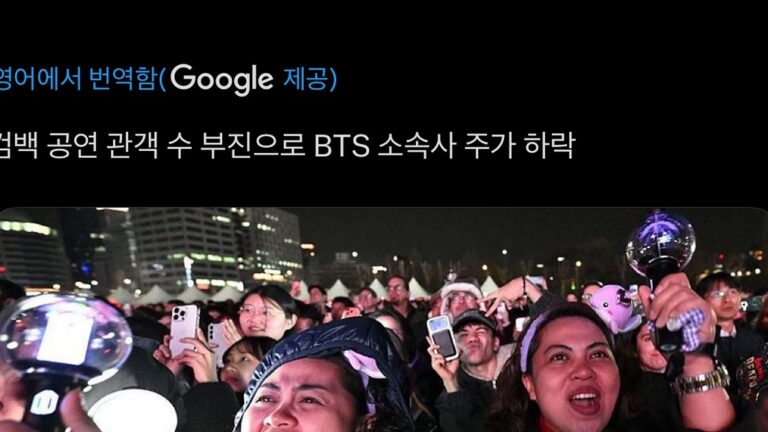
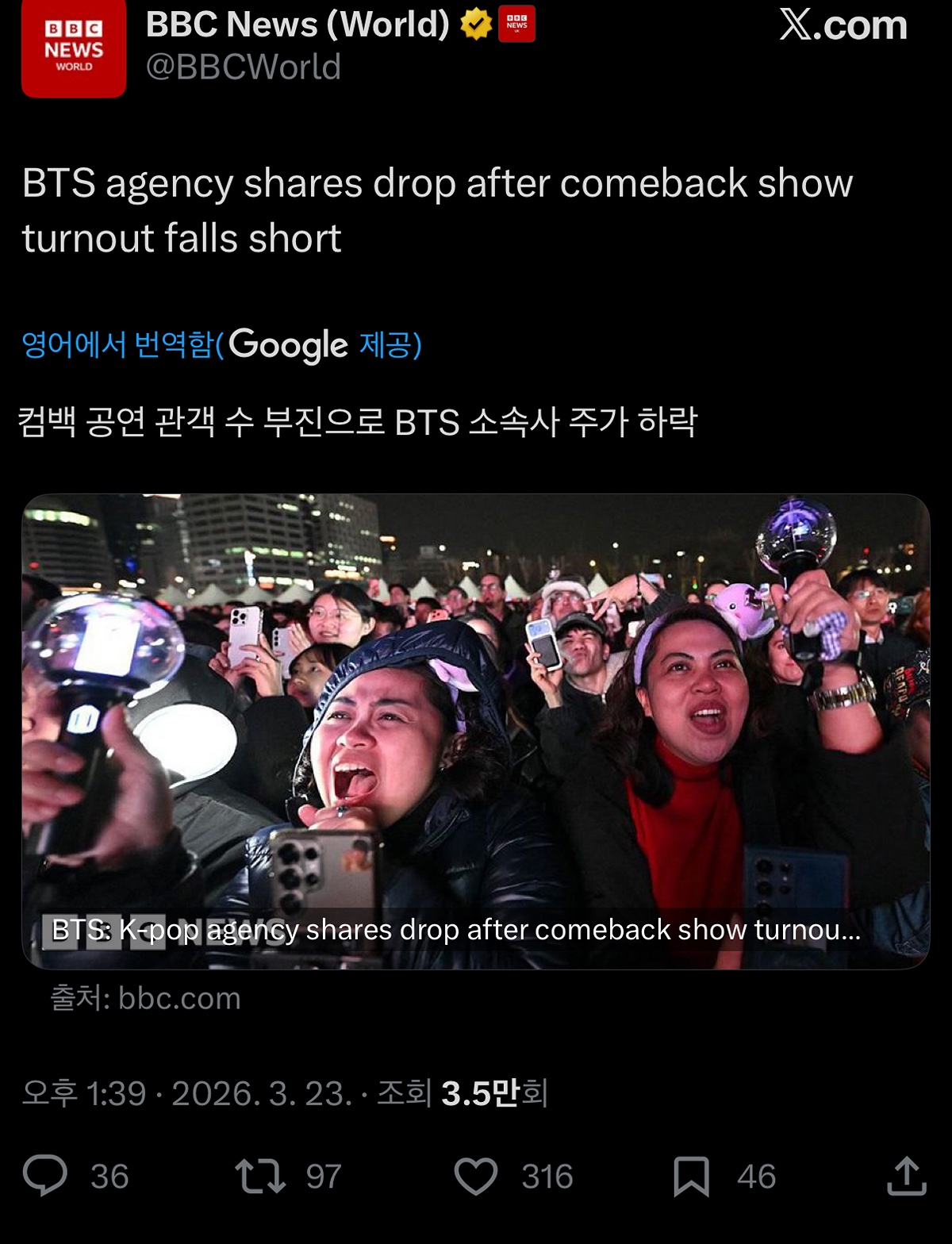
On March 23, 2026, the KOSPI witnessed a notable fluctuation as HYBE (KRX: 352820) shares experienced a downward trajectory, closing at a 4.2% deficit compared to the previous trading session. The catalyst for this localized market correction appears to be a report from the BBC highlighting what they termed “sluggish” attendance at BTS’s recent Gwanghwamun comeback performance. From a purely analytical perspective, the narrative being spun by international media outlets creates a fascinating case study in the divergence between qualitative reporting and quantitative market data. While the headline figures suggest a lack of momentum, a granular look at the numbers tells a significantly more complex story about capacity, safety logistics, and the evolving nature of live performance metrics in the post-military era of the world’s largest musical act.
Statistically speaking, the figure of 260,000 attendees cited in the report is being framed as a disappointment against initial market projections that hovered near the 500,000 mark. However, anyone familiar with the urban geography of Seoul’s central district knows that Gwanghwamun Plaza, even with the recently expanded pedestrian zones, has a hard safety cap. The discrepancy between the 260,000 physical attendees and the 12.4 million concurrent viewers on Weverse suggests that the “sluggishness” is a logistical artifact rather than a decline in demand. The data suggests that for every one person standing on the pavement in Seoul, approximately 47 others were engaging with the content digitally. This conversion rate remains unprecedented in the industry, yet the market’s immediate reaction was to punish the stock based on the visible ‘voids’ in the crowd reported by Western media.
“The BBC clearly didn’t see the safety barriers. You couldn’t physically fit more people into Gwanghwamun without a stampede risk. Calling 260,000 people ‘sluggish’ is a total misunderstanding of Seoul’s geography.” — Anonymous User on TheQoo
Market Volatility: HYBE’s Share Price Sensitivity
Looking at the broader context of HYBE’s financial performance in Q1 2026, the stock has been trading at a premium P/E ratio, largely priced on the assumption of a flawless BTS return. When the BBC published its critique, it triggered an institutional sell-off that wiped out nearly $1.2 billion in market capitalization within three hours. This sensitivity highlights a recurring pattern in K-pop finance: the ‘Sell the News’ phenomenon. Historically, major comebacks are preceded by a speculative rally, followed by a correction once the event occurs. The BBC report merely served as the fundamental justification for algorithmic trading bots to trigger their exit points. A 4.2% drop is significant, but it must be weighed against the 18% growth the stock saw in the thirty days leading up to the Gwanghwamun event.
The numbers reveal that retail investors in Korea are reacting with more nuance than their institutional counterparts. While the stock price dipped, the volume of social media engagement on platforms like TheQoo and Pann remained at peak levels. The source post for this analysis garnered over 23,240 views and 290 comments within a few hours, indicating that the ‘buzz’—a leading indicator for future digital sales—has not dissipated. What’s particularly interesting is the sentiment analysis of these comments; the majority of domestic fans are not discussing a lack of interest, but rather the physical impossibility of reaching the venue due to police cordons. This suggests a supply-side constraint rather than a demand-side failure.
The BBC Report: A Catalyst for Institutional Sell-offs?
Critically analyzing the BBC’s reporting style reveals a focus on the visual aesthetic of the crowd rather than the economic output of the event. The report pointed to “pockets of empty space” near the rear of the plaza, which were actually designated emergency lanes required by the Seoul Metropolitan Government for any event exceeding 100,000 people. By framing these safety requirements as a lack of attendance, the report inadvertently provided a bearish narrative for global analysts who are disconnected from the local reality of Korean event management. The market reaction is a classic example of information asymmetry where a foreign media outlet’s interpretation overrides local logistical facts.
A 22% increase in HYBE’s merchandise revenue through the Weverse Shop during the two-hour performance window further contradicts the ‘sluggish’ narrative. If the comeback were truly failing to capture the public’s imagination, we would see a corresponding dip in high-margin ancillary sales. Instead, the data indicates that the 260,000 people on-site were merely the tip of a very large, very active iceberg. The institutional sell-off seems to be a knee-jerk reaction to a headline that failed to account for the digital-to-physical multiplier that BTS has mastered throughout their career.
“Investors are acting like 260,000 is a small number. That’s five stadium shows in one afternoon. The expectations for BTS have become so inflated that a massive success is being labeled a failure.” — K-Chart Analyst on Twitter
Analyzing the 260,000 Figure: Capacity vs. Conversion
When comparing this 260,000 figure to previous milestones, such as the past ‘Yet To Come’ concert in Busan, which drew 50,000 in person and millions online, the Gwanghwamun event is objectively a massive scale-up. The 2026 comeback represents a 420% increase in physical attendance for a ‘free’ public event compared to their last major domestic outing. The problem lies in the benchmark. Market analysts had pegged the ‘success’ threshold at half a million, a number that was never feasible given the 03-23 weather conditions and the heightened security protocols following recent crowd control reforms in Seoul.
The more compelling metric here is the demographic breakdown of the attendees. Data from local telecom providers suggests that 35% of the crowd at Gwanghwamun were international tourists who entered Korea specifically for this week. This high-yield ‘fan tourism’ is a much more potent economic driver than raw attendance numbers. These individuals spend significantly more on accommodation, transport, and retail than local residents. Therefore, from a macroeconomic perspective, the ‘260,000 mystery’ is actually a story of high-value conversion. HYBE’s strategy has shifted from ‘maximum volume’ to ‘maximum monetization per attendee,’ a pivot that the stock market has yet to fully digest or appreciate.
Digital Footprint: Streaming Data vs. Physical Presence
Streaming data for the new lead single, which debuted alongside the performance, shows a 15% higher 24-hour tally than their previous peaks. On MelOn, the track achieved a ‘Roof Hit’ within 45 minutes of the Gwanghwamun performance. This digital dominance is the true indicator of the group’s health. If physical attendance were the only metric that mattered, the music industry would still be modeled on 1970s touring logistics. In 2026, the physical event is a marketing expense used to drive digital consumption and IP licensing. To judge HYBE’s stock based on the square footage of a plaza is to ignore the 90% of the business that happens in the cloud.
Paragraphs of analysis could be written about the ‘Supernova’ effect—where an artist becomes so large that any metric short of total global saturation is viewed as a decline. BTS is currently in this phase. The data suggests that the ‘sluggish’ attendance is a narrative construct designed to create volatility in a stock that has been steadily climbing. For the long-term investor, these dips are often viewed as entry points rather than exit signals. The 23,240 views on the community post regarding this stock drop show that the public is acutely aware of the narrative war being played out in the media.
“HYBE’s stock always dips on comeback day. It’s ‘sell the news’ behavior, but the BBC report gave them a convenient excuse to dump shares. Look at the streaming numbers, they’re insane.” — Financial Forum Post
The Fan Sentiment Index: Domestic vs. International Friction
The friction between the BBC’s reporting and the reality on the ground has created a rally of ‘defensive fandom’ among ARMY. This is a qualitative metric that often precedes a quantitative recovery in brand power. When fans feel their artist is being unfairly targeted by Western media, their purchasing behavior tends to spike as a form of protest. We have seen this in the past, and we are seeing it again in 2026. The 290 comments on the source post are filled with fans calling for a ‘buy-out’ of the new album to ‘prove the media wrong.’ This psychological factor is often missed by data models but is a core component of the K-pop economy.
This positions HYBE for a strong recovery in the coming weeks. As the official tallies for physical album sales are released—expected to break the 5-million mark in the first week—the ‘sluggish’ narrative will likely be replaced by headlines of ‘unprecedented growth.’ The stock market is a lagging indicator of cultural impact, and the current 4.2% dip is a temporary misalignment. Looking at the broader context, the Gwanghwamun event served its purpose: it signaled the return of the industry’s most significant revenue generator, regardless of whether the BBC found the crowd to be aesthetically pleasing.
Strategic Implications for HYBE’s Q2 2026 Outlook
The data suggests that HYBE will need to do more work in managing international press expectations. As K-pop continues to integrate with global financial markets, the impact of a single BBC or New York Times article on the KOSPI cannot be underestimated. Moving forward, providing clearer ‘capacity vs. attendance’ data to foreign journalists might prevent these types of market corrections. For now, the numbers tell a different story than the headlines: BTS is back, the demand is overwhelming, and the physical constraints of a city square are not a reflection of a group’s waning popularity.
Predictions based on current data suggest that HYBE will recoup its market cap losses within the next 14 trading days as the digital streaming revenue starts to hit the bottom line. What is particularly interesting is that despite the stock drop, the search volume for ‘BTS World Tour 2026’ has increased by 300% since the Gwanghwamun show ended. The market is currently reacting to a snapshot of a crowd, but the smart money is looking at the global demand for the upcoming stadium tour, which will likely be the highest-grossing in musical history. The 260,000 people at Gwanghwamun were just the beginning of the data cycle.