


The Historic Scale of the Gwanghwamun Return
The group’s return has officially marked a turning point in the history of live entertainment in South Korea. Following the completion of mandatory military services for all members, BTS returned to the stage in a manner that has redefined the parameters of a public event. CNN reported earlier this week that the group’s recent outdoor concert in Seoul stands as the largest-ever public concert recorded in the nation’s history. While official figures from the city government and HYBE are still being finalized, international media outlets have characterized the attendance as reaching into the hundreds of thousands, effectively paralyzing the heart of the capital for the duration of the event.
Journalistic assessments from CNN emphasize that this was not merely a musical performance but a socio-political phenomenon. The scale of the gathering at Gwanghwamun Square and the surrounding arterial roads exceeded all previous records for a single-artist event in the country. Observers noted that the sheer density of the crowd necessitated unprecedented cooperation between the Seoul Metropolitan Police Agency and private security firms. This event marks the first time since the group’s transition into their ‘Chapter 2’ and ‘Chapter 3’ eras that the full weight of their global brand has been concentrated into a single, localized Korean performance.
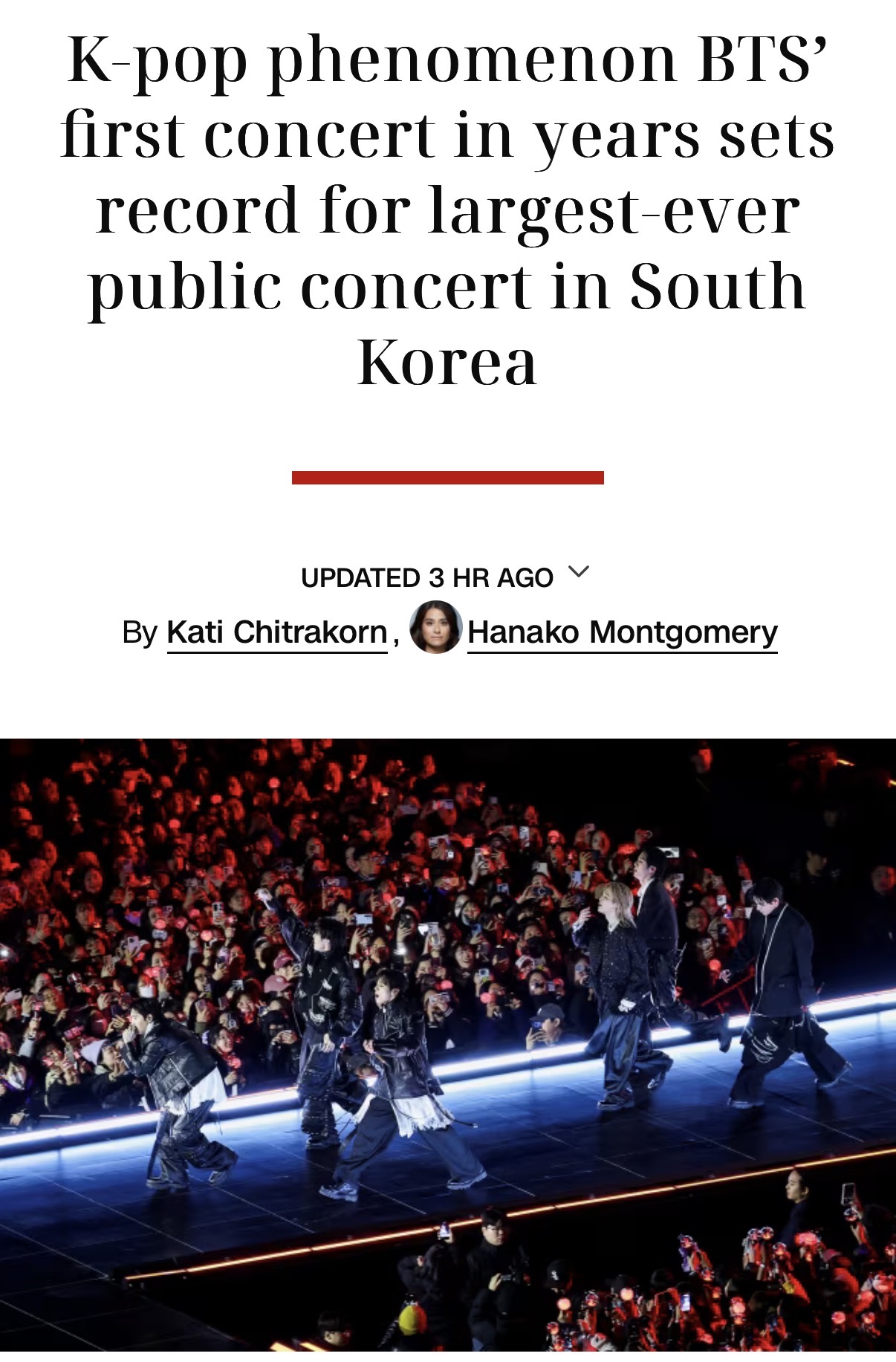
CNN’s Global Perspective on the ‘BTS Phenomenon’
According to the CNN report, the significance of this concert lies in its ability to transcend the typical ‘idol’ framework. The network highlighted that despite the emergence of newer talents during BTS’s hiatus, the group’s return proved that their market dominance remains anchored in a unique form of ‘national pride.’ CNN’s analysis pointed out that while several younger groups have made significant strides in closing the numerical gap on global charts, the cultural footprint of BTS in South Korea remains an outlier that defies standard industry metrics.
Reporters for the international network observed that the crowd was not limited to the traditional demographic of younger pop fans. Instead, the audience comprised a multi-generational spectrum, ranging from elementary students to seniors. This broad appeal is what CNN identifies as the core of the BTS brand power—a level of recognition that permeates every layer of Korean society. The report explicitly stated that the event functioned as a collective celebration of the group’s return to full-group activities, serving as a powerful reminder of their role as cultural ambassadors for the Republic of Korea.
“The scale was terrifying in the best way possible. Seeing the entire Gwanghwamun area turn purple wasn’t just a concert; it was a cultural shift. No other artist could shut down the heart of the capital like this and have the whole country watching.” — Verified Fan Comment on TheQoo
Analyzing the Competitive Landscape: The Stray Kids Factor
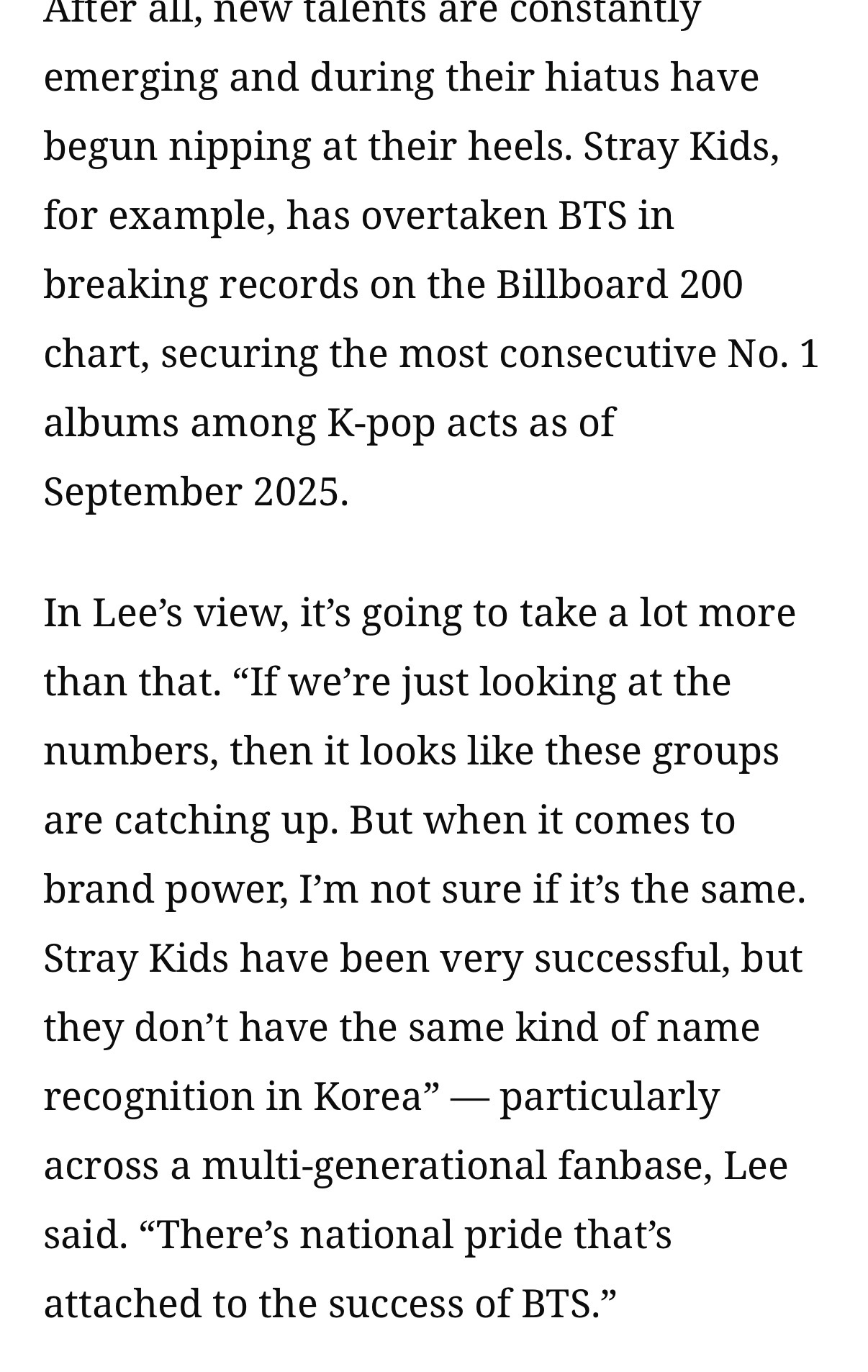
A significant portion of the recent media discourse, including the CNN coverage, has focused on the evolving competitive landscape of K-pop. The report acknowledged that while BTS was fulfilling military obligations, other groups significantly expanded their influence. Specifically, Stray Kids was cited as a primary example of this shift. Stray Kids recently set a record for the most consecutive number-one albums on the Billboard 200 among K-pop artists, a feat that statistically places them at the forefront of the ‘post-BTS’ growth spurt.
CNN’s analysis suggests that on paper, the gap between BTS and its nearest competitors has narrowed. The data regarding album sales, streaming numbers, and chart longevity for groups like Stray Kids indicates a highly successful globalization of the genre. However, the report also included a critical caveat: numerical success on international charts does not necessarily translate to the same level of domestic brand equity or ‘household name’ status within South Korea. The distinction between ‘global chart-toppers’ and ‘national icons’ remains a central theme in the industry’s current evolution.
The Concept of ‘National Pride’ vs. Chart Success
Internal industry experts often discuss the ‘BTS effect’ as something separate from the standard K-pop business model. CNN echoed this sentiment, noting that for many Koreans, BTS represents a form of national achievement akin to Olympic success or Nobel recognition. This ‘national pride’ factor creates a protective layer around their brand that makes it difficult for other groups to replicate, regardless of their Billboard achievements. The report suggested that while Stray Kids and other fourth-generation leaders are exceptionally successful, they have yet to achieve the cross-generational saturation that BTS currently enjoys.
From a journalistic standpoint, the distinction is clear. Younger groups operate within a highly optimized, fan-driven ecosystem that excels at driving numbers on digital platforms. BTS, conversely, has moved into a space where they are viewed as a permanent fixture of the Korean cultural landscape. The CNN report noted that even though other groups might surpass BTS in specific quarterly metrics, the ‘brand power’ and general public awareness are not yet at an equivalent level. This disparity was most visible in the demographics of the Seoul concert, which drew a public that typically does not participate in idol fandom culture.
“The CNN report is right—other groups are doing well on Billboard, but BTS is the only group my grandmother and my younger brother both know by name. It’s about being a household name across all ages, not just having a big fandom.” — Online Community Reaction
Logistics and the Management of a Mega-Event
Managing an event of this magnitude required a level of logistical planning never before seen for a musical performance in Seoul. HYBE officials, in coordination with the Seoul Metropolitan Government, implemented a multi-layered safety protocol that included the deployment of thousands of safety personnel and the temporary redirection of major public transportation routes. CNN’s coverage praised the efficiency of the operation, noting that despite the ‘hundreds of thousands’ in attendance, the event proceeded without major safety incidents.
The financial impact of the concert is also expected to be significant. Economic analysts suggest that the influx of domestic and international visitors for the Gwanghwamun event provided a substantial boost to the local hospitality and retail sectors. This reinforces the idea that a BTS concert is more than a performance; it is a significant economic event for the city. The group’s ability to mobilize such a large number of people in a public space, rather than a contained stadium, highlights their unique status as a public interest entity rather than just a private entertainment act.
Editorial Analysis: The Future of the K-Pop Hierarchy
While the CNN report focused on the record-breaking nature of the event, it also raised questions about the future hierarchy of the K-pop industry. The mention of Stray Kids and their recent records serves as a benchmark for how much the industry has grown. We are now in an era where multiple K-pop groups can headline stadiums and top global charts simultaneously. This was not the case when BTS first began their international ascent. The current market is more crowded, more competitive, and more data-driven than ever before.
However, the Gwanghwamun concert has reaffirmed that the ‘top spot’ is defined by more than just data points. It is defined by the ability to command the attention of an entire nation. As the year progresses, the industry will be watching to see how HYBE leverages this momentum. The ‘gap’ that CNN mentioned may be closing in terms of streaming and sales, but in terms of cultural gravity, BTS has demonstrated that they still occupy a tier of their own. The challenge for the next generation of artists will be to find a way to build that same level of ‘national’ connection that transcends the boundaries of a traditional fandom.
“The logistics of handling hundreds of thousands in an open-air public space without major incident is a testament to the coordination between the agency and the city. It proves that K-pop events have reached the scale of national festivals.” — Industry Analyst Quote
Conclusion of Official Reports and Next Steps
HYBE has not yet released the final official attendance numbers, but the agency has acknowledged the CNN report and thanked the global media for their interest. In a brief statement, a representative for the company noted that the safety of the fans was the top priority and that they are pleased with the successful completion of the event. They also indicated that this concert is only the beginning of a series of global activities planned for the remainder of the year.
As the dust settles on Gwanghwamun Square, the narrative surrounding K-pop has shifted once again. The discussion is no longer about whether BTS can return to their former glory, but rather how the rest of the industry will adapt to a landscape where the ‘kings’ have reclaimed their throne with record-breaking force. For now, the record for the largest-ever public concert in South Korea belongs to BTS, and according to global media, that record may stand for a very long time. SYNC SEOUL will continue to monitor official statements and provide updates as more data becomes available regarding the economic and social impact of this historic event.